

Let’s be honest.
Being young today is really tough. There is a lot of pressure to have a good career, earn money, stay healthy, have good relationships, and have their whole life planned out before they turn 30. And social media adds a level to this by showing us how others are enjoying their life.
Many of us are dealing with stress, anxiety, overthinking, and confusion about what we really want in life.
But we have a solution for our every problem. More than 5000 years ago, Arjuna faced a similar situation; he was confused, overwhelmed, and unable to make a decision. At that time Lord Krishna (incarnation of Lord Vishnu) shared the wisdom that became the Bhagavad Gita. A book that guides us to handle life’s challenges and make better decisions.
And honestly, the lessons are more relevant today than ever.
Table of Contents
Arjuna’s Battle Is Similar to Our Battle
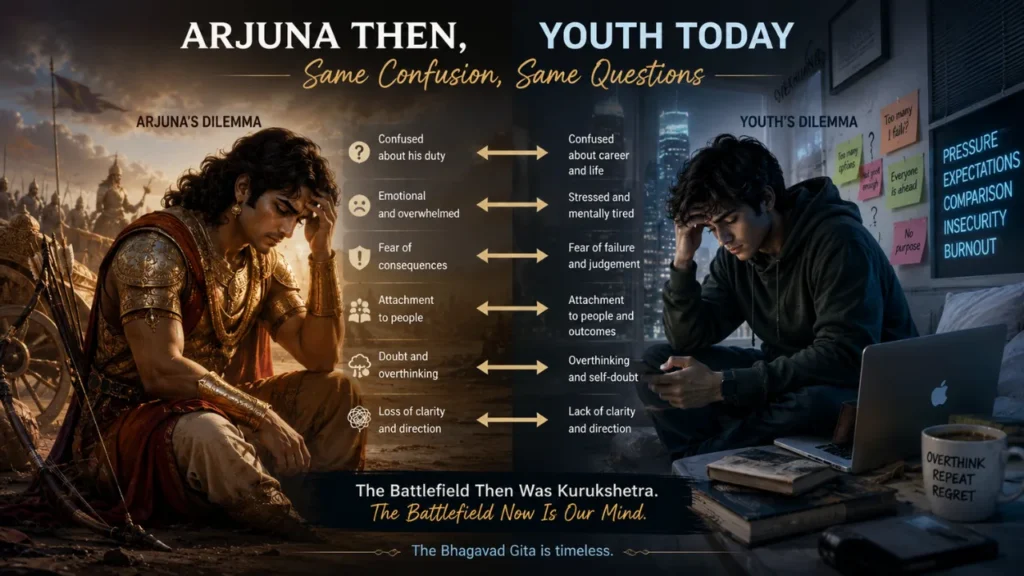
When we hear “battlefield,” we imagine swords, warriors, etc.
But the real fight is with ourselves. The battle against self-doubt, procrastination, anxiety, fear of failure, social media comparison, and all.
| Arjuna’s Problem | Gen Z’s Problem |
|---|---|
| Fear of consequences | Fear of failure |
| Overthinking | Analysis paralysis |
| Self-doubt | Imposter syndrome |
| Emotional breakdown | Anxiety and stress |
| Lack of clarity | Career confusion |
Arjuna was confused about what to do, and many of us feel exactly the same while choosing a career, handling relationships, or taking decisions for the future.
The Bhagavad Gita begins with confusion but ends with clarity. These lessons will help you to find the answers to your questions and clarity in life.
Lesson 1: Focus on Effort, Not Results
One of the most famous teachings of the Bhagavad Gita is:
“You have a right to perform your actions, but not to the fruits of those actions.”
In simple words, do your best and stop worrying about the results.
Just think about it—you prepare for an exam or a job interview or start a business or create content online.
You can’t control the results, but you can control your efforts. Many people suffer because they get obsessed with outcomes; if they don’t get the desired result, they get anxious or stressed.
But the Gita teaches us to focus on the process instead.
When you stop worrying about results all the time, you will enjoy the process, feel less stressed, and perform better.
Lesson 2: Stop Comparing Yourself to Others
In today’s life, social media has turned comparison into a daily habit.
You start feeling small when someone buys a car, gets a promotion, travels to another country, or gets famous overnight.
Remember, everyone has their own journey, and your path is different from someone else’s path. You can’t reach your destination by following their way.
Comparing your progress to others is like comparing a mango tree to a coconut tree. But you know, both grow differently and both have value.
It is your journey; own it!
You have to accept the challenges before the rewards. The only person you should compare yourself to is the person you were yesterday.
Lesson 3: Learn to Control Your Mind
See, the mind can be your best friend or the worst enemy. The choice is totally yours.
Most problems begin in the mind; one negative thought becomes ten and can ruin your day.
You have to control your mind so that it works in your favor.
Some simple ways to do this include:
- Meditation
- Journaling
- Spending less time on social media
- Practicing gratitude
- Spend time in nature
A calm mind makes better decisions.
Lesson 4: Discipline Is More Powerful Than Motivation
You get energetic after watching a motivational video. But have you ever noticed that it doesn’t last long?
Some days you feel inspired, and you work, but after a few days you don’t want to do anything. And this is very normal.
The Bhagavad Gita teaches the importance of steady action. Success doesn’t come from feeling motivated every day. It comes from showing up consistently.
Whether you learn a new skill, go to the gym, improve English, or build a business, you have to be disciplined.
It doesn’t matter if you’re feeling energetic or not; just do the work and fulfill the promise you made to yourself.
Lesson 5: Failure Is Part of Growth
We’ve been scolded for failing since we were kids, and the fear of failure has taken a place in our minds.
Everyone sees failure as a negative thing, but failure is proof that you are trying. Every successful person has failed many times. The Bhagavad Gita teaches us not to be afraid of setbacks.
Failure is not the opposite of success. It is part of success.
Every mistake teaches something valuable. Every rejection helps you grow. Every setback prepares you for a comeback.
Instead of asking, Why did this happen to me? Try asking, What can I learn from this? That small shift can change everything.
Lesson 6: Stay Calm During Difficult Times
You can’t escape challenges. When you solve one problem, a new and upgraded problem is waiting for you.
There will be rejections, losses, disappointments, and unexpected changes, but you have to stay calm.
The Bhagavad Gita teaches emotional balance; it doesn’t mean ignoring emotions, it means not letting emotions completely control your actions.
The strongest people are not those who never struggle. They are the ones who stay steady during difficult situations.
Lesson 7: Become the Best Version of Yourself
The Bhagavad Gita is a book about self-improvement. It focuses on practical actions, emotional control, and spiritual growth.
Lord Krishna encourages Arjuna to rise above doubts, fear, and confusion. The message applies to us.
Every day is a new opportunity to become more disciplined, more confident, more focused, and more aware.
Growth is not about becoming perfect. It’s about becoming better than you were yesterday.
What Would Krishna Tell Gen Z Today?
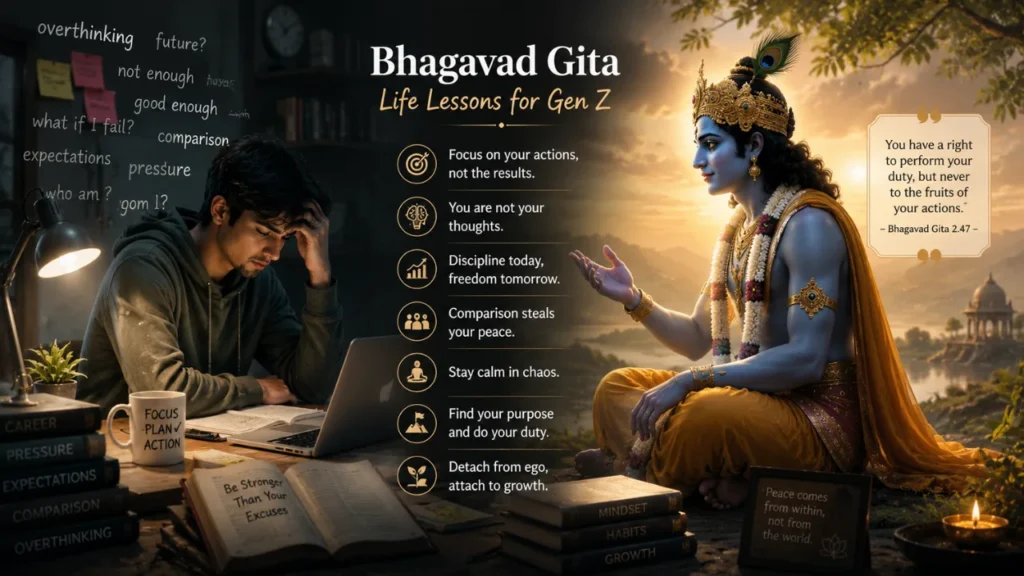
If Krishna were speaking to the young today, his message might sound something like this:
- Stop comparing your life to social media highlights.
- Focus on what you can control.
- Take action instead of overthinking.
- Learn from failures.
- Control your mind before it controls you.
- Build discipline.
- Stay calm during challenges.
- Trust the process.
Conclusion
The Bhagavad Gita has survived for thousands of years because its lessons are timeless. Even today it shows us the right path because human struggles are the same. We still experience fear, confusion, stress, and uncertainty.
The Bhagavad Gita doesn’t promise a problem-free life. Instead, it teaches us how to face life’s challenges with wisdom, courage, and clarity.
Arjuna’s battlefield was Kurukshetra. For many of us, the battlefield is our own mind.
If you think with a calm mind, you have the solutions to your problem in your hands; you just need the right guidance—the Bhagavad Gita.