Have you ever thought about why Hindu texts talk about ages of the world? Why do they describe a time when truth and goodness were everywhere and another time when chaos and greed were common?
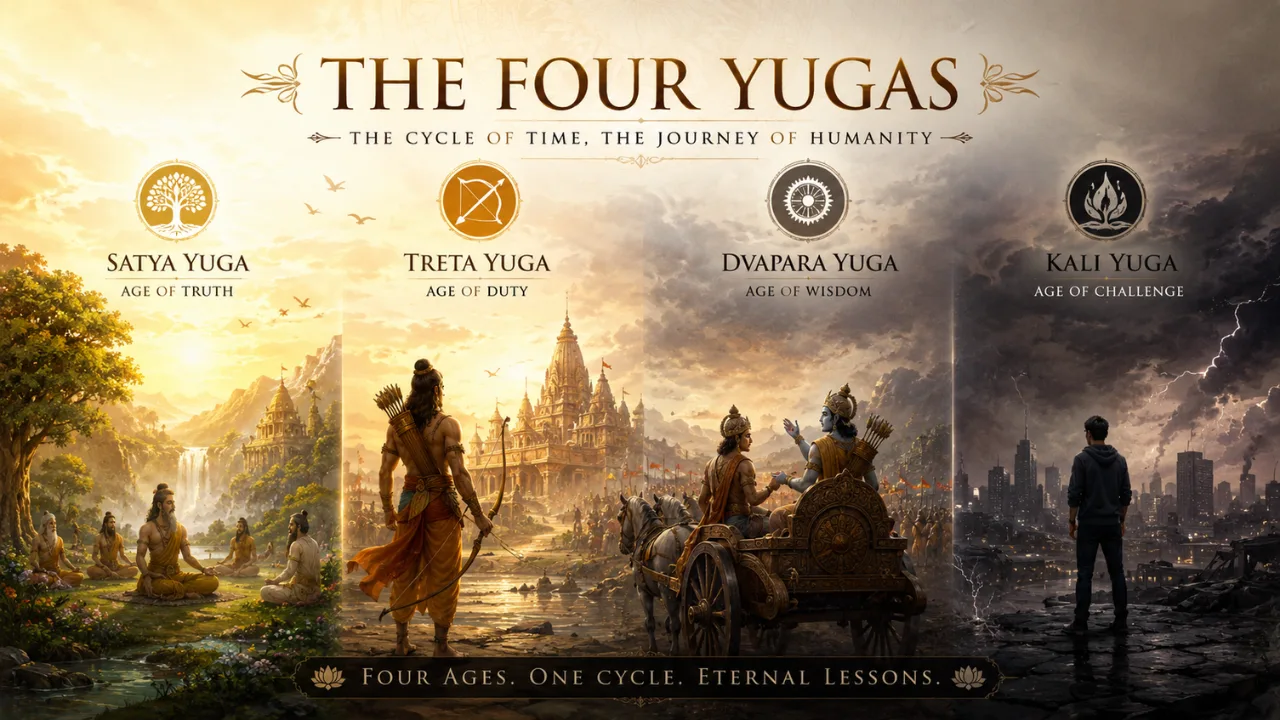
According to Hindu tradition, time does not move in a line. It moves in cycles like the changing seasons. These cycles are called the Four Yugas: Satya Yuga, Treta Yuga, Dvapara Yuga, and Kali Yuga.
Each Yuga represents a time in human spiritual growth. When one Yuga ends, another starts, bringing changes in values, society, and peoples’ relationships with God.
Let us look at these four ages in simple terms.
Table of Contents
What Is a Yuga?
A Yuga is a Sanskrit word that means an age or era. In Hindu scriptures these four Yugas repeat in a cosmic cycle.
The Four Yugas are:
- Satya Yuga
- Treta Yuga
- Dvapara Yuga
- Kali Yuga
A simple way to understand them is to imagine a table with four legs.
In the Satya Yuga all four legs are strong, showing goodness and truth. As each Yuga passes one leg becomes weaker. By the time Kali Yuga comes, one leg is left, showing the end of moral and spiritual qualities.
Satya Yuga: The Golden Age of Humanity
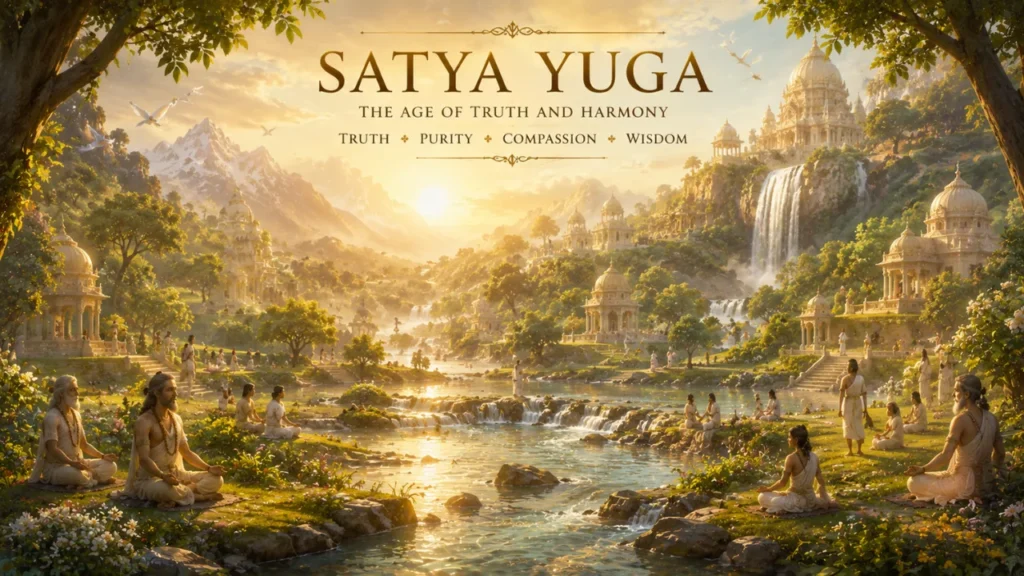
Satyayuga is also called the Golden Age of Humanity.
During this age, truth, kindness, and fairness were normal. People lived in harmony with nature. Followed their duties without being forced. There was little greed, dishonesty, or conflict.
It is said that people lived longer lives and had great spiritual knowledge. Meditation and devotion were the powers of that time.
Imagine a world where honesty was the norm, people respected each other, and spiritual growth was more important than wealth. That is what Hindu texts say about the Satya Yuga.
This age is considered the most peaceful and spiritually advanced of all the Yugas.
Treta Yuga: The Age of Duty and Sacrifice
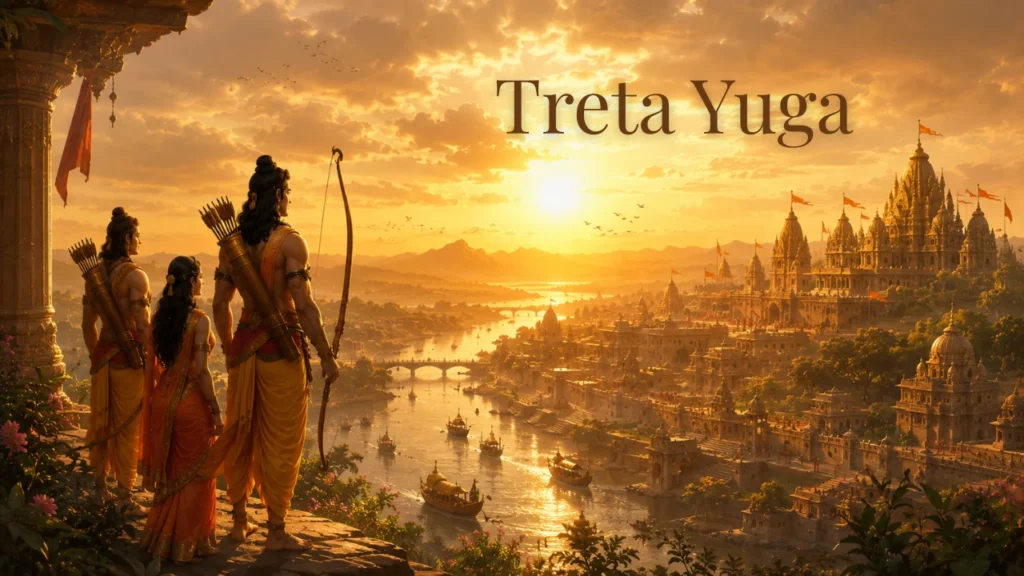
When Satya Yuga ended, humanity entered Treta Yuga.
Although goodness was still present, it was not perfect. People started to have desires, goals, and conflicts.
Treta Yuga is best known for the story of the Ramayana.
Lord Rama was born during this time to embody the importance of truth, duty, and selflessness. His life teaches us lessons about doing the right thing even in difficult situations.
The story of Rama’s exile, Sita’s devotion, Hanuman’s loyalty, and Ravana’s defeat still inspires people today.
Treta Yuga reminds us that doing the right thing is not always easy, but it is always worth it.
Dvapara Yuga: The Age of Change
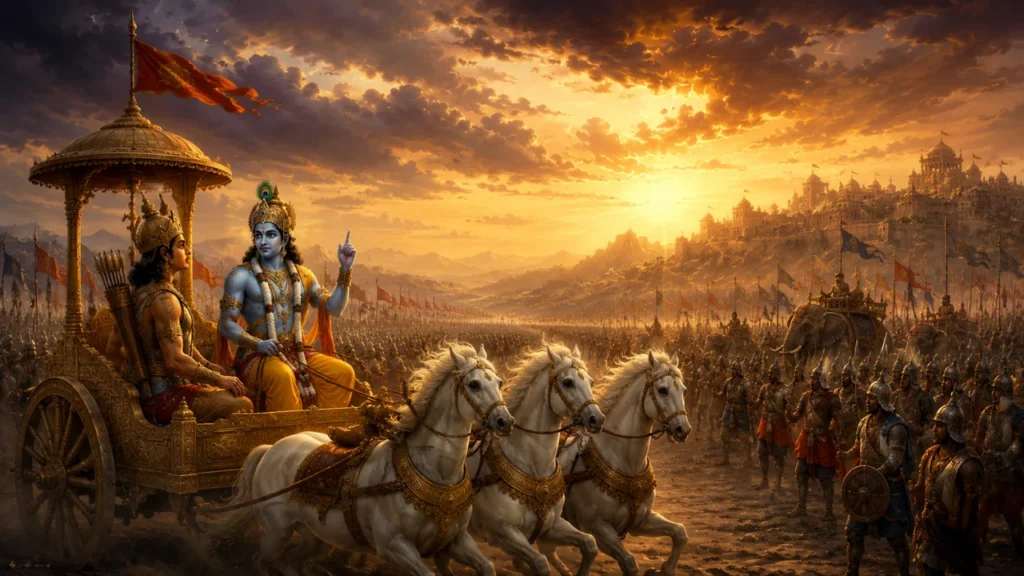
The next stage in the cycle is Dvapara Yuga.
In this age good and evil existed together. Society became more complex. People faced greater moral challenges.
Dvapara Yuga is associated with Lord Krishna and the events of the Mahabharata.
The great battle of Kurukshetra took place during this age. Before the battle Lord Krishna taught Arjuna the Bhagavad Gita, which answers the questions about duty, life, and spirituality.
Unlike the Satya Yuga, people in the Dvapara Yuga often struggled to distinguish right and wrong.
The lessons of Lord Krishna continue to guide people through life’s challenges.
Kali Yuga: The Present Age
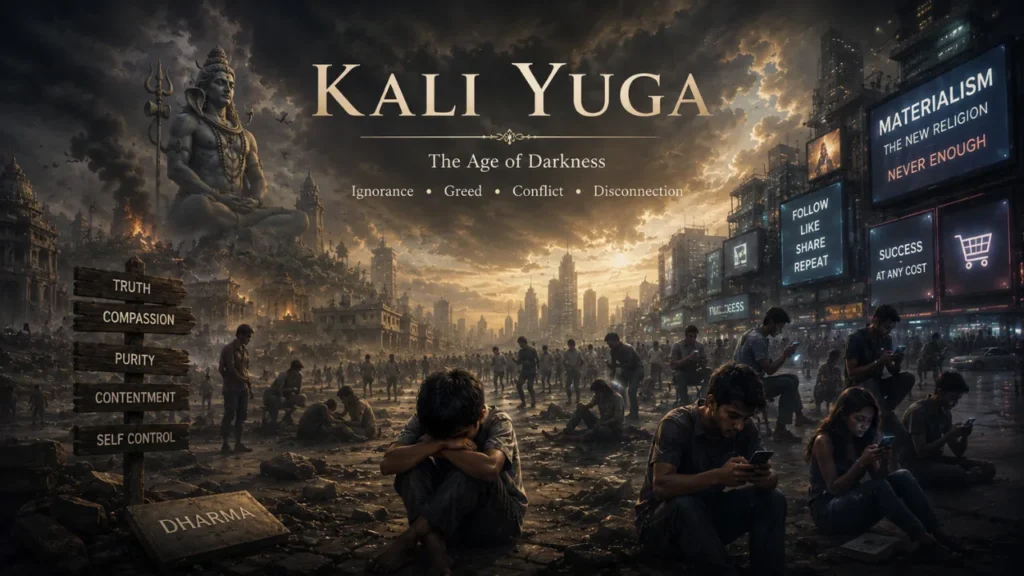
According to Hindu beliefs, we are currently living in the Kali Yuga.
This is the last age of the cycle.
The Kali Yuga is described as a time when material desires are more important than spiritual virtues. People become more concerned with wealth, power, and personal gain. Truth is overlooked. Conflicts become more common.
Many people are surprised to learn that Hindu scriptures do not describe Kali Yuga as hopeless.
In fact, they say that spiritual growth is still possible. While the challenges may be greater, dedication, prayer, meditation, and good deeds are still effective ways to find inner peace.
It is said that in Kali Yuga spiritual liberation can be achieved by chanting the names of God (Kali Yuga kewal naam adhaara).
This is a reminder that even in difficult times people can choose kindness, honesty, and compassion.
How Long Does Each Yuga Last?
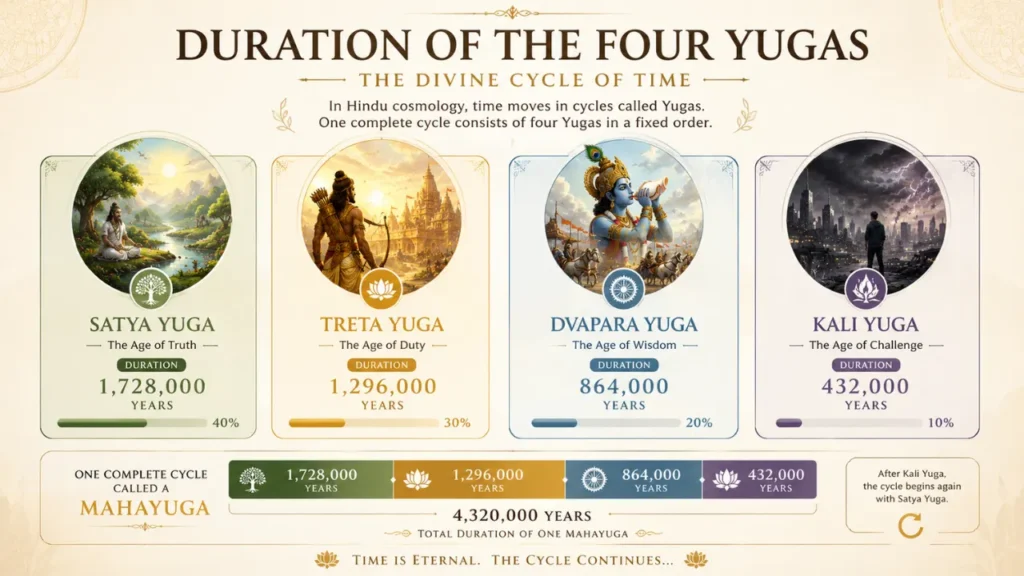
Traditional Hindu texts assign the following durations to the four Yugas:
| Yuga | Duration |
|---|---|
| Satya Yuga | 1,728,000 years |
| Treta Yuga | 1,296,000 years |
| Dvapara Yuga | 864,000 years |
| Kali Yuga | 432,000 years |
Together these four Yugas form one cycle called a Mahayuga.
What Happens After Kali Yuga?
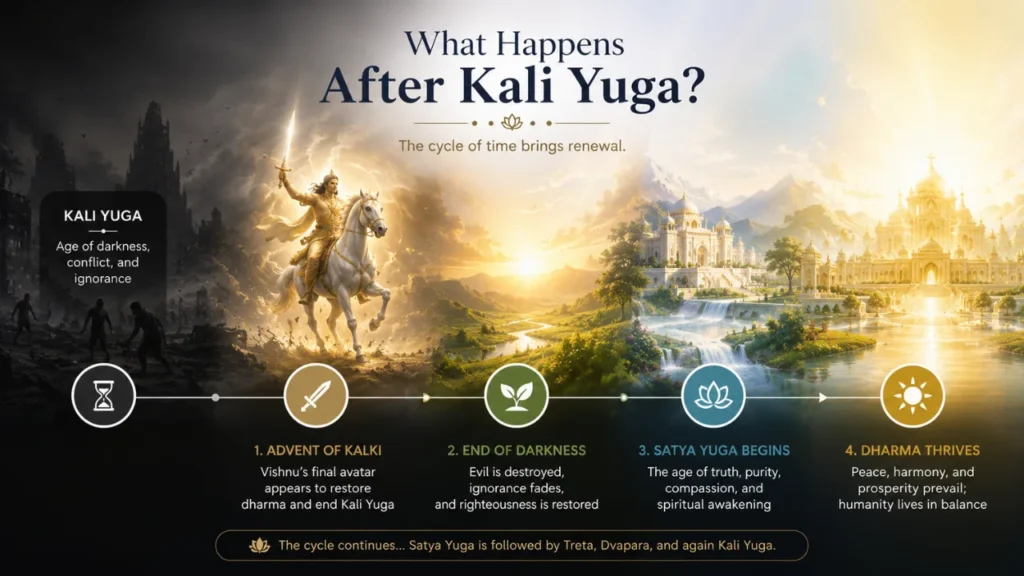
According to Hindu belief, the Kali Yuga will eventually end.
At that time Lord Kalki, the avatar of Lord Vishnu, is believed to appear and restore goodness.
With the rebirth of Dharma, a new Satya Yuga will begin. The cycle will repeat.
This idea shows a Hindu belief: no period of darkness lasts forever. Renewal and transformation are always possible.
What Can We Learn from the Four Yugas?
The Four Yugas are not stories of the past or future. They teach us lessons for our lives.
Satya Yuga teaches us the importance of truth, Treta Yuga teaches duty and sacrifice, and Dvapara Yuga teaches about wisdom and devotion. Kali Yuga teaches us to have faith during difficult times.
Whether we see the Yugas as periods, symbolic lessons, or spiritual principles, their message remains relevant: human values are important, and everyone can contribute to a better society.
Conclusion
The Four Yugas are the most fascinating concept in Hindu philosophy.
From the peace of the Satya Yuga to the hardships of the Kali Yuga, each era reflects a part of the human experience.
Perhaps the encouraging lesson is that while the world around us changes, we always have the choice to live with honesty, compassion, and faith.
That lesson is timeless no matter which Yuga we live in.