
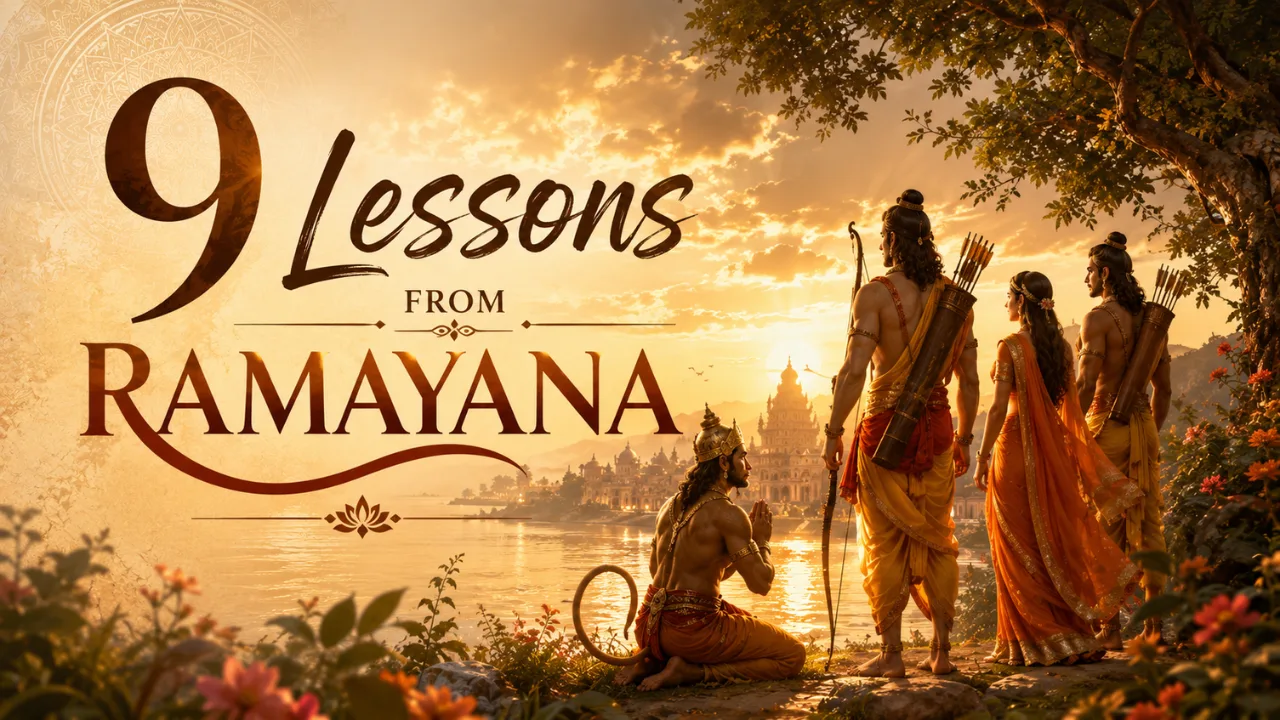
In India, the Ramayana is one of the most loved epics. We see it as the story of Rama, Sita, Lakshamana, and Hanumana. But if we look a little deeper, it’s not just an ancient text; it teaches us the lessons that are very useful in modern lives.
It talks about honesty, patience, loyalty, courage, kindness, and making the right choices even when life becomes difficult. So let’s have a look at some of the biggest lessons from the Ramayana.
Table of Contents
Always Stand by the Truth
Lord Rama’s entire life is based on Dharma. Even in difficult times, he chose the road of truth, righteousness, and peace.
Even when he was asked to spend 14 years in exile, he accepted that just to fulfill his father’s promise.
In today’s environment, moral conflicts arise at work, in relationships, and even among individuals. In such cases we should remember that the truth may challenge us, but it will not destroy us. So doing the right thing is more important than doing the easy thing.
Keep Your Promises
King Dashrath granted two boons to Kaikeyi when she saved his life by driving his chariot in the battlefield. Years later he kept his words, even that promise broke his heart.
Likewise, Rama kept his father’s word and left the kingdom willingly.
It teaches us that our words have value. When people know they can trust what we say, our relationships become stronger.
True Friendship Stands in Difficult Times
In his journey, Rama met many loyal friends like Sugriva and Hanuman. Especially Hanuman, he remained devoted to Rama and faced every challenge without expecting anything in return.
A true friend stands by you during hard times, not just when things are going well.
Loyalty Is One of the Greatest Strengths
Lakshman’s devotion to his brother Rama is one of the Ramayana’s most heartwarming moments. He left the comfort of the palace and spent fourteen years in the forest with Rama.
Even in the hardships his loyalty never changed.
Being there for your loved ones in difficult times shows true character.
Never Let Ego Control You
Ravana was the son of the sage Vishrava and the demoness Kaikasi. He was the great devotee of Lord Shiva, had knowledge of all four Vedas, and was a powerful demon king, but his pride and ego overpowered his wisdom.
He ignored good advice from people like Vibhishana and Mandodari. His refusal to admit his mistake eventually led to his downfall.
No matter how talented we are, ego can destroy everything if we stop listening to good advice.
Patience Brings Better Results
Rama didn’t rush into battle. He carefully planned every step, built alliances, and waited for the right time. He showed that patience is not weakness—it’s wisdom.
Good decisions often come from staying calm instead of reacting quickly.
Good Leadership Means Serving Others
We call Ram Purushottam, meaning the best of men, and Ram Rajya is remembered as the ultimate example of leadership.
Even before becoming king, Rama always thought about the well-being of others. A true leader earns respect by helping people, making right decisions, and taking responsibility.
Teamwork Can Achieve the Impossible
Building the bridge to Lanka was not easy; it wasn’t the work of one hero. It was possible because everyone—from Hanuman to the smallest squirrel—played their part.
Big goals are only possible when everyone contributes, no matter how small their role may seem.
Courage Is Not the Absence of Fear
Rama, Hanuman, and the Vanarsena faced many dangerous situations. They were not brave because they had no fear—they were brave because they continued to move forward despite it.
Real courage means doing what is right even when you are afraid.