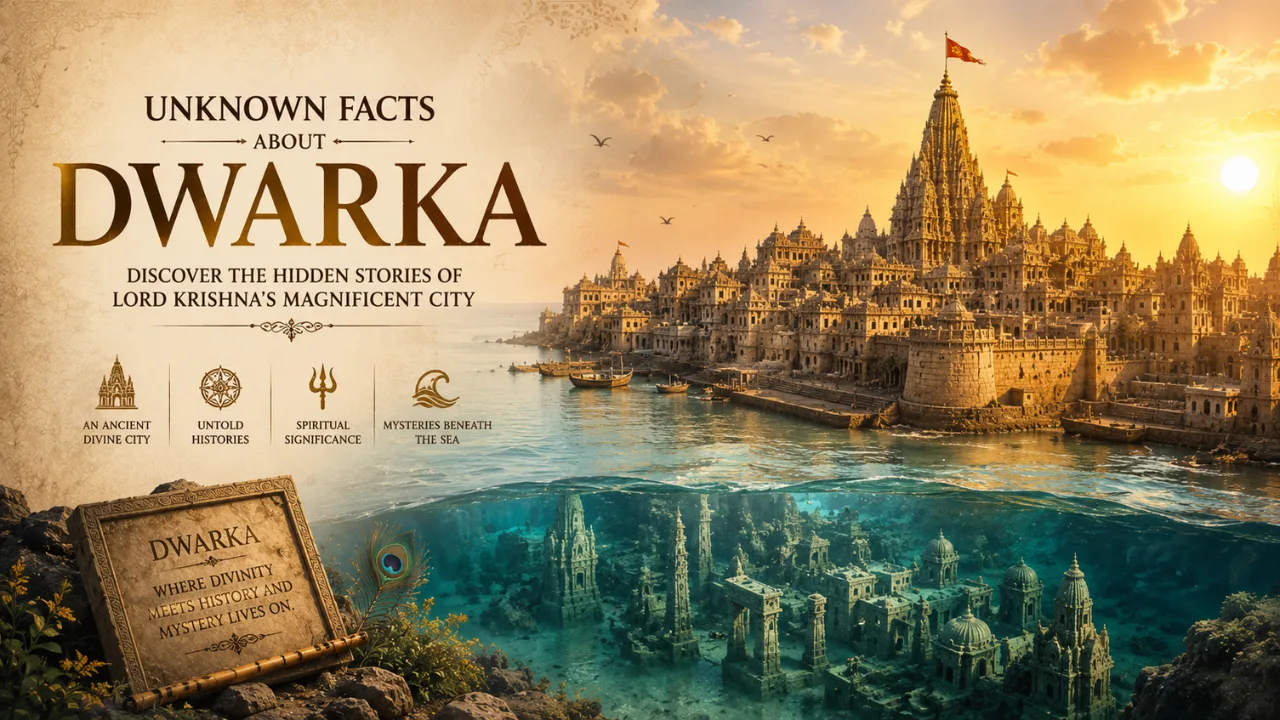
History describes Krishna’s Dwarka as a city that shines like gold, with grand places, wide roads, and divine architecture.
Today’s Dwarka (in Gujarat) is very different from what it was thousands of years ago.
The kingdom of Lord Krishna, Dwarka, is not only a pilgrimage site but also a place where mythology, history, archaeology, and mystery come together in a fascinating way.
Let’s explore some of the interesting and lesser-known facts about this legendary city that very few people know.
Table of Contents
1. Why did Krishna move to Dwarka?
Krishna was born in Mathura and spent his childhood in Vrindavan. After defeating Kamsa, Krishna started ruling Mathura.
But the Magadha king, Jarasandha (father-in-law of Kamsa), wanted to take revenge for Kamsa’s death. So he attacked Mathura several times.
To protect his people, Krishna decided to relocate the Yadavas far away from this danger to the western coast.
Dwarka wasn’t his first choice—but a solution to protect an entire civilization.
2. Dwarka Was Built by Vishwakarma
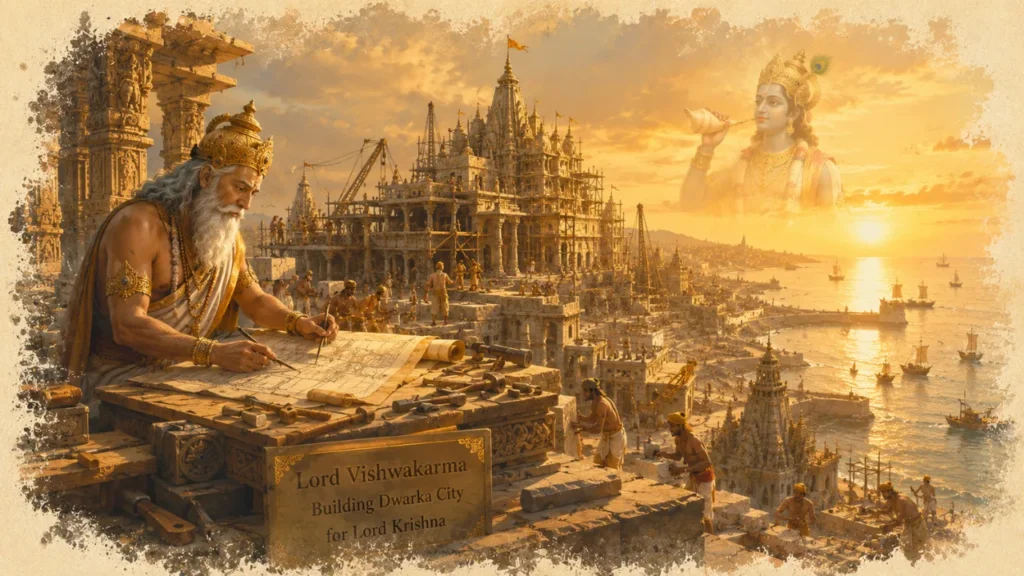
According to Hindu mythology, Dwarka was built for Lord Krishna by the divine architect Lord Vishwakarma.
The story says that Krishna requested land from the sea god (Samudra deva). The sea receded and provided land on which Lord Vishwakarma constructed the beautiful city with palaces, temples, gardens, and wide streets.
Ancient texts describe Dwarka with a level of detail that is rarely seen in mythology.
3. Original Dwarka Is Believed to Be Underwater
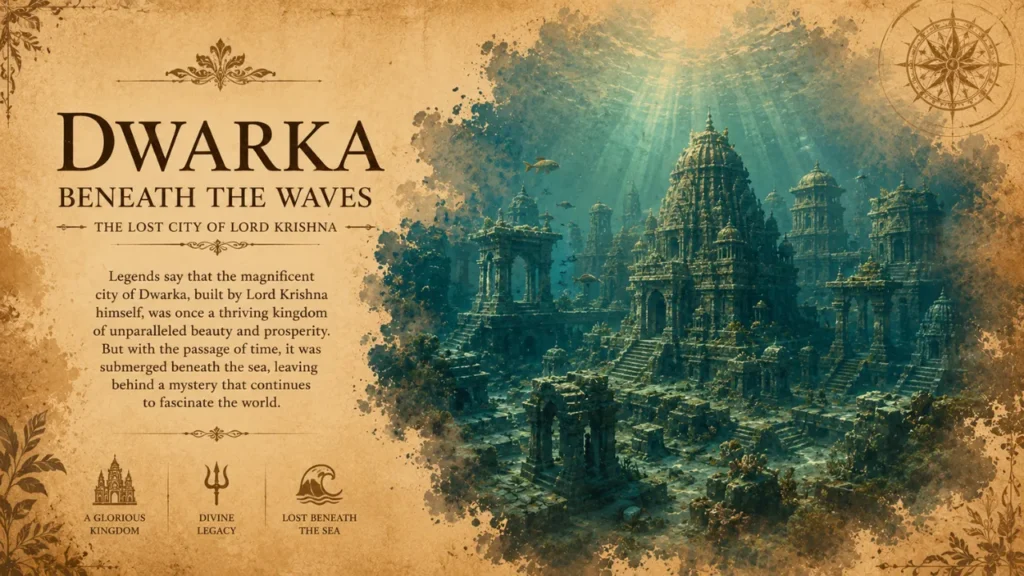
The most intriguing fact is the belief that the original city now lies beneath the Arabian Sea.
According to mythology, after Krishna left the Earth, the sea gradually swallowed the city within it. The Mahabharata mentions that soon after the departure of Krishna, the city disappeared beneath the sea.
For years, many considered it a legend, but then archaeology entered the picture.
4. Underwater Discovery of Dwarka
During the late 20th century, marine archaeologists conducted underwater research near the present-day Dwarka.
During the studies, they discovered stone structures, walls, anchors, and other remains under the sea.
These discoveries sparked a global interest because they seemed to support the possibility that an ancient settlement existed in that area.
However, experts are doing deep research here to find the exact age and significance of these discoveries. But of course, this adds a fascinating layer to the story of Dwarka.
5. Dwarka has been rebuilt more than once
Some beliefs suggest that Dwarka was not just destroyed once.
The city may have been rebuilt multiple times over centuries due to natural disasters, rising sea levels, and coastal changes.
This theory may explain why different archaeological remains from different periods have been found around this area.
6. Dwarka Appears in Multiple Hindu Scriptures
Dwarka is not mentioned in only one text. References to the city can be found in:
- Mahabharata
- Bhagavata Purana
- Vishnu Purana
- Harivamsa
The repeated mention of Dwarka in many important scriptures shows its importance in Hindu tradition and mythology.
7. Temple Flag Is Changed Several Times Every Day
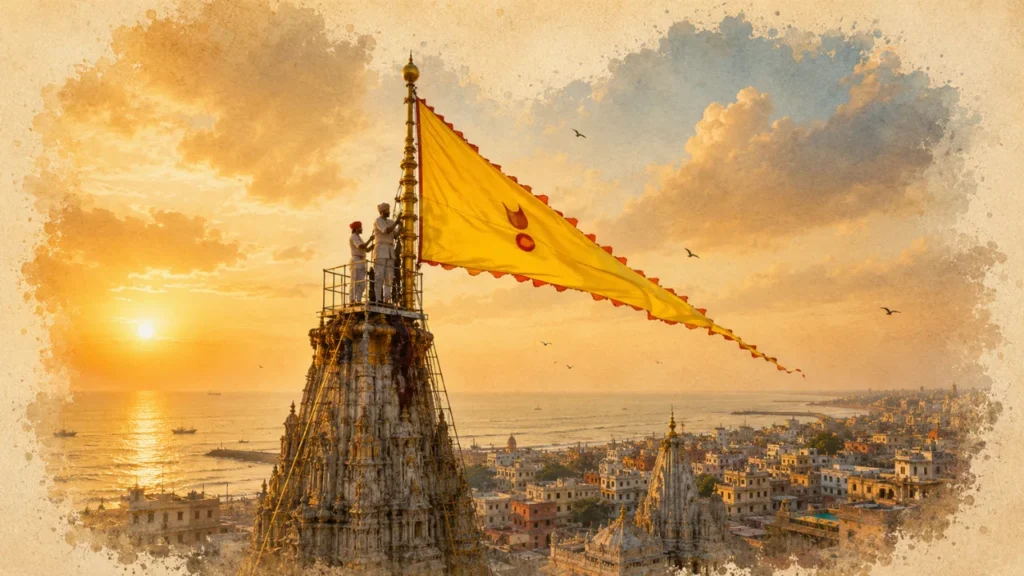
One of the most unique traditions of the Dwarkadhish Temple is the changing of the temple flag.
The flag, known as the Dhwaja, is changed several times each day. Devotees consider it a great honour and a very auspicious act to hoist a new flag at the temple.
This centuries-old tradition continues today and is one of the most special rituals of the temple.
8. Dwarka Is One of the Char Dham Pilgrimage Sites
Very few people know that Dwarka is one of the four sacred Char Dham pilgrimage sites established by Adi Shankaracharya.
The Char Dham pilgrimage sites, also known as Bada Char Dham, are:
Completing the Char Dham pilgrimage is considered highly sacred in Hinduism.
Conclusion
Few places in the world blur the line between mythology and history like Dwarka.
The city, said to have been built by the hands of gods, ruled by Lord Krishna, and finally overtaken by the sea, is one of India’s greatest mysteries. The more we learn about Dwarka, the more fascinating it becomes.
Maybe that is why the story of the kingdom lost under the waves still fascinates people.