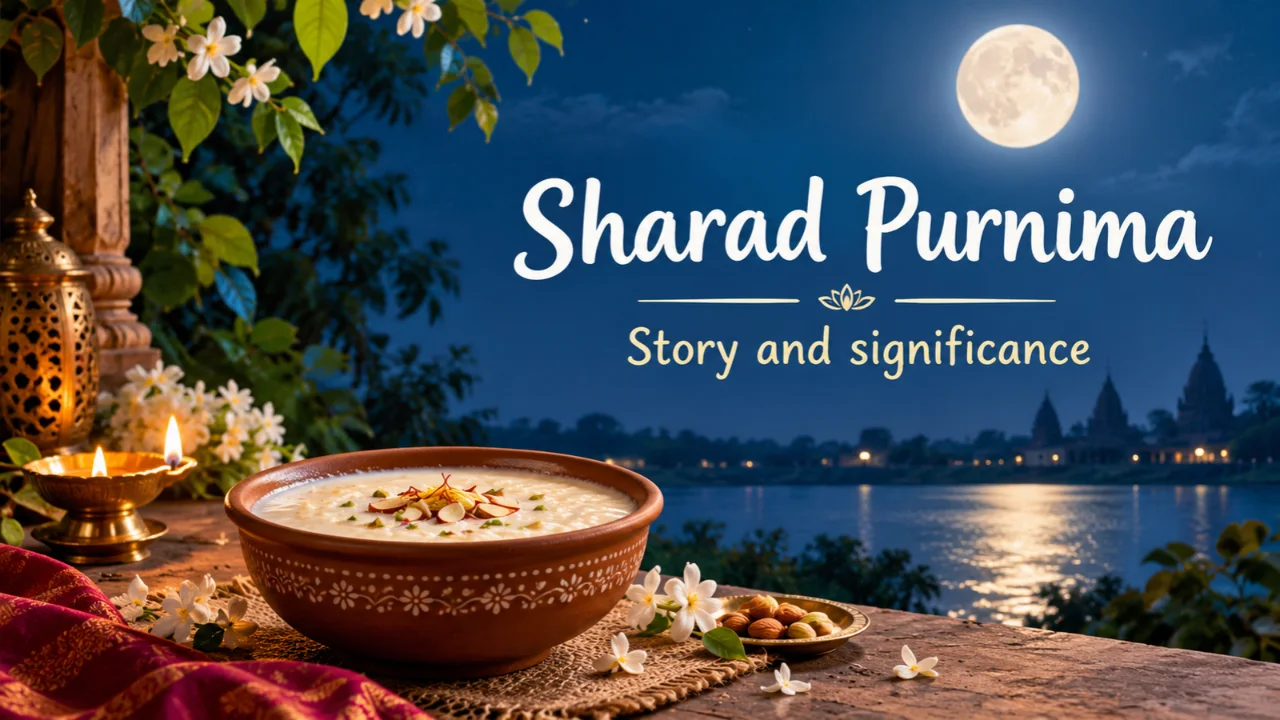
There are many festivals in India that are closely connected to nature, and Sharad Purnima is a beautiful example of this. It is celebrated on the full moon day of autumn, when the skies become clear and the nights begin to feel cooler.
Celebrated in the Ashwin month, it brings together old stories, devotion and some interesting traditions that have been followed for generations.
Table of Contents
What is Sharad Purnima?
Sharad Purnima is the full moon day of the Hindu month of Ashwin, which usually falls around September or October.
This festival is known by different names in different regions. In Gujarat, it is commonly called Sharad Poonam. In the Braj region, it is associated with Raas Purnima, while in eastern India, it is known as Kojagari or Kojagara Purnima. In traditional texts, it is also known as Kaumudi Purnima.
Why is Sharad Purnima important?
There are many beliefs behind the significance of this full moon. According to tradition, the moon shines with all its 16 kalas on this night. Its rays are believed to have special, nourishing properties and are compared to amrit (divine nectar). For this reason, food items—most notably kheer, a traditional milk and rice preparation—are typically placed outdoors in the moonlight. Devotees also worship Chandra Deva (the moon god) on this night.
In the Braj region, the festival is celebrated as Raas Purnima, the night when Krishna performed the Maha-Raas (dance of divine love) with the Gopis.
In many areas, this night is also considered important for the worship of Goddess Lakshmi. According to Kojagara tradition, Goddess Lakshmi is believed to descend to earth at night and bless those who stay awake in devotion.
Story of Sharad Purnima and Lord Krishna
According to mythology, on this night the melodious sound of Krishna’s flute echoed through Vrindavan. Hearing the music, the Gopis left behind all worldly ties, family obligations, and societal judgments (lok-laaj) and ran to the banks of the Yamuna river.
To honor their pure devotion, Krishna manifested himself beside each Gopi so that everyone could experience his presence and performed Maha-Raas—the divine dance of love.
Krishna miraculously stretched the night so it matched the divine night of Brahma, which lasted for millions of human years, celebrating the divine dance of the soul (jivatma) and the Supreme soul (paramatma).
Sharad Purnima and Goddess Lakshmi
Sharad Purnima has another popular aspect in Eastern India, where the full moon is associated with Kojagari or Kojagara Puja, dedicated to Goddess Lakshmi.
The word Kojagara means ‘who is awake?’ It is believed that Goddess Lakshmi descends to earth on this night and blesses those who stay awake in devotion and prayer. Devotees offer prayers around midnight in Nishita Kala to invite Maa Lakshmi.
Why is Kheer kept under moonlight?
This is the most common tradition observed on this night. Families prepare rice kheer (a pudding made from rice, milk, and sugar) and place it in the moonlight. It is believed that the moonlight on this night has nourishing properties like nectar. Therefore, the kheer is left in the open moonlight and eaten as prasad the next day.
Sharad Purnima is a beautiful reminder of how Indian festivals often bring nature, faith and family together. Traditions are centuries old, but the faith remains the same among the new generation. Perhaps that’s the magic of Sharad Purnima—an age-old tradition that still gives us a reason to stop, look up at the sky, and enjoy the moment.