

Somnath isn’t just another famous temple. Its story is thousands of years old and filled with devotion, legends, destruction, reconstruction, and faith.
Located in Prabhas Patan, near Veraval, Gujarat, it is one of the 12 Jyotirlingas dedicated to Lord Shiva. This is an important pilgrimage site with many stories, so let’s explore them and understand what makes this temple so special.
Table of Contents
Story Behind Somnath Temple

The story of Somnath begins with Lord Chandra, who was married to the 27 daughters of King Daksha. But Chandra had a special affection for Rohini, one of the wives, and failed to treat the others fairly.
Angered by this, Daksha cursed Chandra, causing his brightness to slowly disappear.
Chandra prayed to Lord Shiva at Prabhas Patan and performed deep penance. Pleased with his devotion, Lord Shiva blessed him and reduced the effect of the curse that the moon would wax and wane during the month.
This is how Shiva came to be known as Somnath—Soma is another name of Chandra, and nath means lord; together it means Lord of Soma.
Why Is Somnath a Jyotirlinga?
Traditionally, Somnath is regarded as the first of the 12 Jyotirlingas of Lord Shiva.
According to Hindu belief, the Jyotirlinga represents the divine, radiant form of Shiva. The word Jyotirlinga comes from Jyoti, meaning light, and Linga, representing Lord Shiva.
For devotees, having the darshan of the Jyotirlinga is deeply meaningful. And standing at Somnath, with the sea spreading out behind the temple, it is easy to see why this site has possessed such spiritual importance for generations.
Destruction and Reconstruction of Somnath Temple
Over the centuries, the temple faced several attacks and was destroyed and rebuilt multiple times. Yet, despite all this, its importance as a sacred place never diminished.
One of the most famous attacks took place in 1026 CE, when Mahmud of Ghazni attacked Somnath. The temple was looted and damaged but was later rebuilt.
After India gained independence, the idea of rebuilding Somnath was revived. Sardar Vallabhbhai Patel strongly supported the temple’s reconstruction, considering it an important symbol of India’s heritage. The present temple is built in the traditional Chaulukya style, and the reconstruction was completed in the 1950s.
Beautiful Architecture of Somnath Temple
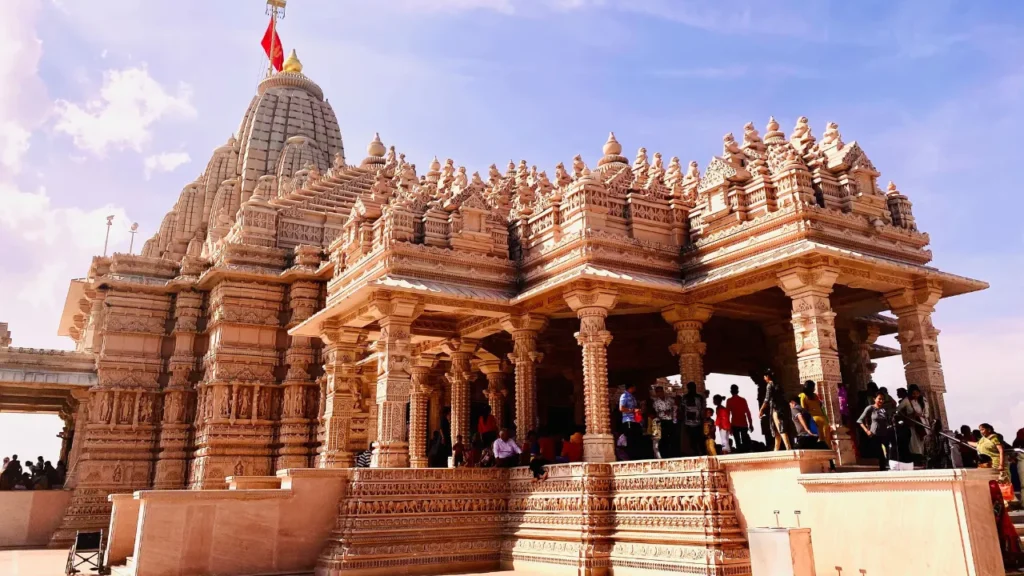
The Chaulukya style of architecture gives the Somnath Temple a grand and beautiful appearance.
The tall shikhara rises prominently against the sky, while detailed carvings add character to the structure.
One of the most beautiful things about Somnath is its location. The temple is right next to the Arabian Sea, offering spectacular views, especially at sunrise and sunset.
There’s also an interesting feature called Baan Stambh, or the Arrow Pillar. The pillar bears an inscription that states there’s no land directly south until Antarctica. It’s a small detail, but many visitors find it interesting.
What Is the Best Time to Visit Somnath?
Somnath can be visited throughout the year, but the cooler months are generally more comfortable for exploring the temple and nearby attractions.
October to March is a popular period because the weather is usually more pleasant.
If you wish to visit the temple during a major festival, Mahashivratri is particularly special. It is beautifully decorated and visited by a large crowd of devotees.
Somnath Temple Darshan and Aarti
The temple has a regular schedule of darshan and rituals, with Aarti being one of the most beautiful experiences for the devotees.
The aarti near the sea has a special atmosphere. The sound of bells and chants combined with the ocean in the background creates a memorable spiritual experience.
Places to Visit Near Somnath
A trip to Somnath can easily include several nearby historical and spiritual places.
- Bhalka Tirth—According to Hindu tradition, this place is associated with the final moment of Lord Krishna’s earthly life
- Triveni Sangam—Triveni Sangam at Prabhas Patan is considered the meeting point of three rivers: Hiran, Kapila, and Saraswati. The place has great religious significance.
- Gita Mandir—A temple where the Bhagavad Gita is inscribed on 18 pillars.
- Surya Mandir—An ancient sun temple featuring detailed stone carvings of animals and flowers.
- Ahilyabai Temple—Opposite the main Somnath Temple, this temple is called the Old Somnath Temple, which was built by Maratha queen Ahilyabai Holkar.
- Shree Chandrabhaga Shaktipeeth—Also known as Prabhas Patan Shakti Peeth, it is believed that the stomach of Goddess Sati fell here.
How to Reach Somnath Temple
Somnath is well connected to other parts of Gujarat.
By air: The nearest airport is in Diu, about 80-90 km away. Depending on your route, Rajkot and other airports may also be considered. Why Pay More for the Same Flight? Get the best deals on flight bookings.
By train: Somnath has its own railway station, making it convenient for visitors travelling by train.
By road: Somnath is well-connected by road to cities such as Ahmedabad, Rajkot, Junagadh, and Dwarka. People usually travel here by bus, taxi, or private car.
If you are planning a temple tour of Gujarat, you can combine Somnath with Dwarka for a beautiful spiritual journey through some of the state’s most important pilgrimage sites.
Final Thoughts
A trip to Somnath is a blend of faith, history, and travel. The temple has an incredible story, but its serene location on the shores of the Arabian Sea makes the experience even more special.
Whether you’re visiting as a pilgrim or simply a traveler seeking to learn more about India’s heritage, Somnath has something for you.