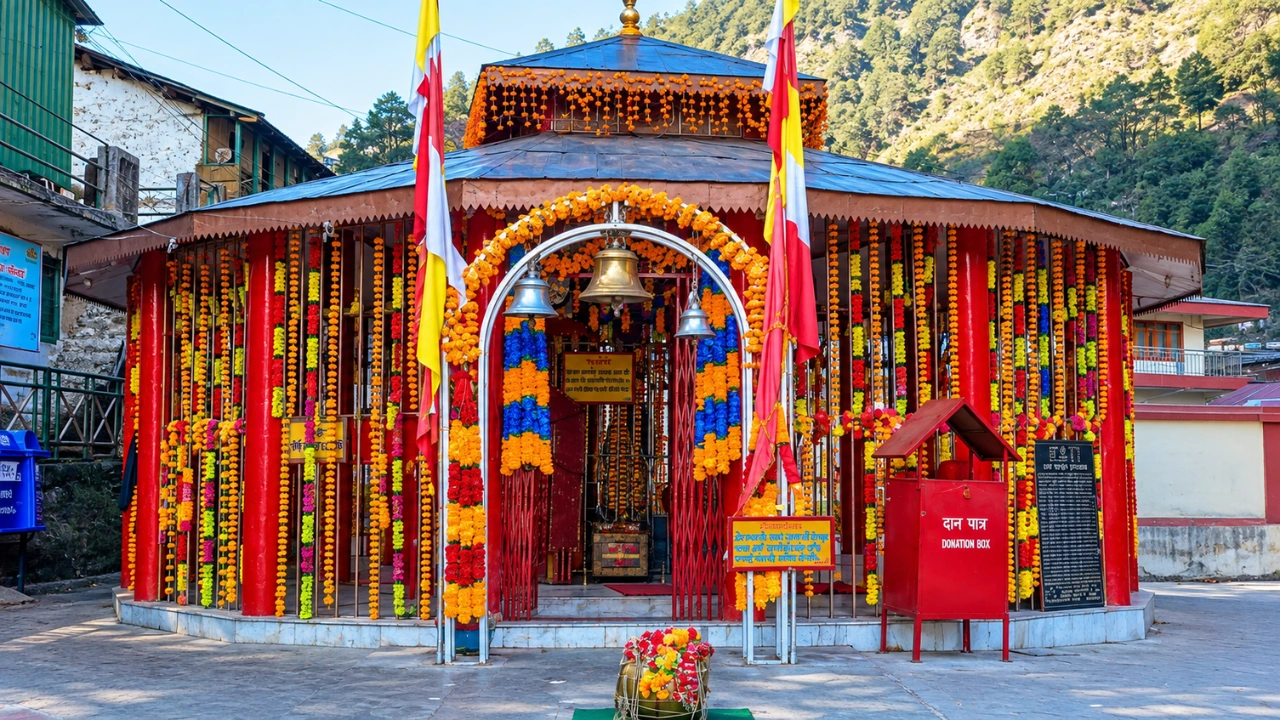
The story of Maa Kali and Raktbeej is one of the most powerful tales in Hindu mythology. In the Garhwal Himalayas of Uttrakhand, the Kalimath temple is closely associated with this story. It holds a special place in the worship of Shakti, however, there is no traditional idol of Maa Kali in the shrine.
Its unusual traditions and fascinating mythology make it one of the most interesting spiritual destinations in the state.
Table of Contents
Where Is Kalimath Located?
Kalimath is a small pilgrimage village in the Rudraprayag district of Uttarakhand. It is in the Garhwal Himalayas, near Guptkashi and Ukhimath, in the Kedarnath region.
The village is sitting at a height of around 1800 meters above sea level, beside the banks of the Saraswati River, which is locally known as Kali Ganga. Kalimath is primarily known for its ancient temple of Maa Kali. It is visited by many devotees throughout the year, and the Navratri festival is particularly important.
Story of Maa Kali and Raktbeej
According to Hindu mythology, Raktabeej was a powerful demon who had received a special boon. Every drop of his blood that fell on the ground could give birth to another demon just like him. This made him extremely difficult to defeat, as each injury would create even more enemies.
Goddess Durga manifested Maa Kali during the battle, who prevented his blood from falling to the ground and finally defeated him and ended his threat to the world.
According to local belief, after defeating the demon, Maa Kali disappeared from the place now known as Kalimath. This story is an important part of the temple’s spiritual identity. For devotees, it represents the power of the Goddess to destroy evil and protect the world from harmful forces.
Unique Aspects of Kalimath
1. Maa Kali Is Worshipped in a Unique Form
Unlike most Hindu temples, Kalimath doesn’t have any traditional idol of the goddess. Instead, devotees worship a sacred Sri Yantra, which is placed over a sacred kund in the temple. According to local tradition, this is the exact spot where the goddess descended into the earth after defeating Raktbeej.
2. It Is Considered a Siddha Peeth
Kalimath is regarded as a Siddha Peeth, a sacred place associated with spiritual power and devotion. It is also one of the important 108 Shakti Peeths, it is believed that the lower half of the divine feminine resides here. This temple holds a special place in the religious traditions of the Garhwal region and its importance increases even more during Navratri.
3. Rare Trinity Temple
There are three distinct temples within the temple complex dedicated to the supreme forms of the divine feminine. Goddess Lakshmi and Goddess Saraswati are worshipped here alongside Goddess Kali. The Mahalakshmi temple is in the center, flanked by Mahakali on the right and Mahasaraswati on the left.
4. Connection With Dhari Devi Temple
Kalimath is also linked with the Dhari Devi Temple, which is another significant shrine dedicated to the goddess in Uttarakhand. According to local religious tradition, the lower part of the goddess’s form is worshipped at Kalimath, while the upper part is worshipped at Dhari Devi.
5. Gauri-Shankar and Bhairav Shrines
The temple complex also features the Gauri-Shankar Temple dedicated to Lord Shiva and Goddess Parvati. Lord Bhairava is also worshipped here in the Bhairavnath Temple, holding great significance in the area, as he is revered as the Kshetrapal (protector of the area).
Kalimath During Navratri
Navratri is one of the most important times to visit Kalimath. During Sharadiya Navratri, celebrated around September and October, the temple receives special attention. The Shri Yantra, which remains covered throughout the year, is brought out only on the eighth day (Ashtami) of Navratri for public darshan and a special midnight ritual.
The atmosphere becomes even more devotional when people come to pray and participate in religious practices.
Places to Visit Near Kalimath
If you have some extra time, you can explore a few other spiritual destinations nearby.
Guptkashi– It is an important pilgrimage town in the Rudraprayag district and a practical stop to explore the Kedarnath region. It is famous for the old Vishwanath Temple and its ties to the rich tradition of Shiva worship.
Ukhimath– It is another important religious site in the region. It is associated with the winter worship of the Kedarnath and Madhyamaheshwar deities, when their main temples are closed during the winter season.
Triyuginarayan Temple– Located in the Rudraprayag district, Triyuginarayan Temple is associated with the traditional story of the marriage of Lord Shiva and Goddess Parvati. A sacred fire burns in the temple’s havan kund, and devotees associate it with the divine marriage.
Dhari Devi Temple– The Dhari Devi Temple, located on the banks of the Alaknanda River, is one of the most well-known goddess temples in the area. Its religious traditions are very similar to those of Kalimath, making it a good place to include in a larger pilgrimage.
Best Time to Visit Kalimath
The best time to visit Kalimath is generally from spring to autumn, when road travel and exploring the surrounding area is often more comfortable. March to June is a good time to visit the mountains, the weather is generally good during the day. September to October is a popular period for devotees, especially during Sharadiya Navratri.
How to Reach Kalimath Temple
Kalimath can be reached by road from other places in the Garhwal region of Uttarakhand.
By Road– You can head to Guptkashi or Ukhimath and take a taxi or other local transport to Kalimath. Shared vehicles are available depending on the weather and route.
By Train– Rishikesh is one of the main railway access points for this part of Uttarakhand. From there, you can travel by road to Rudraprayag, Guptkashi, and Kalimath.
By Air– Jolly Grant Airport near Dehradun is the nearest major airport commonly used by travellers visiting this region. You will need to continue by road from the airport. Book your flights at the best prices.
Travel Tips for Visiting Kalimath
- Wear comfortable shoes and pack warm clothes, as temperatures can change quickly.
- Check the weather forecast and road conditions before you set out, especially during monsoon and winter.
- Dress modestly inside the temple and respect local traditions.
- Carry some cash for convenience.
- If you are planning to visit during Navratri, check the temple timings and ceremony schedule in advance.
Kalimath is one of those places where the story behind the temple is as fascinating as the place itself. Its connection to Goddess Kali, the tale of Raktabeej, and the unique worship of the goddess make it an important part of Uttarakhand’s spiritual heritage.
It is a great place for anyone interested in India’s sacred places and the stories that have kept their traditions alive for generations.