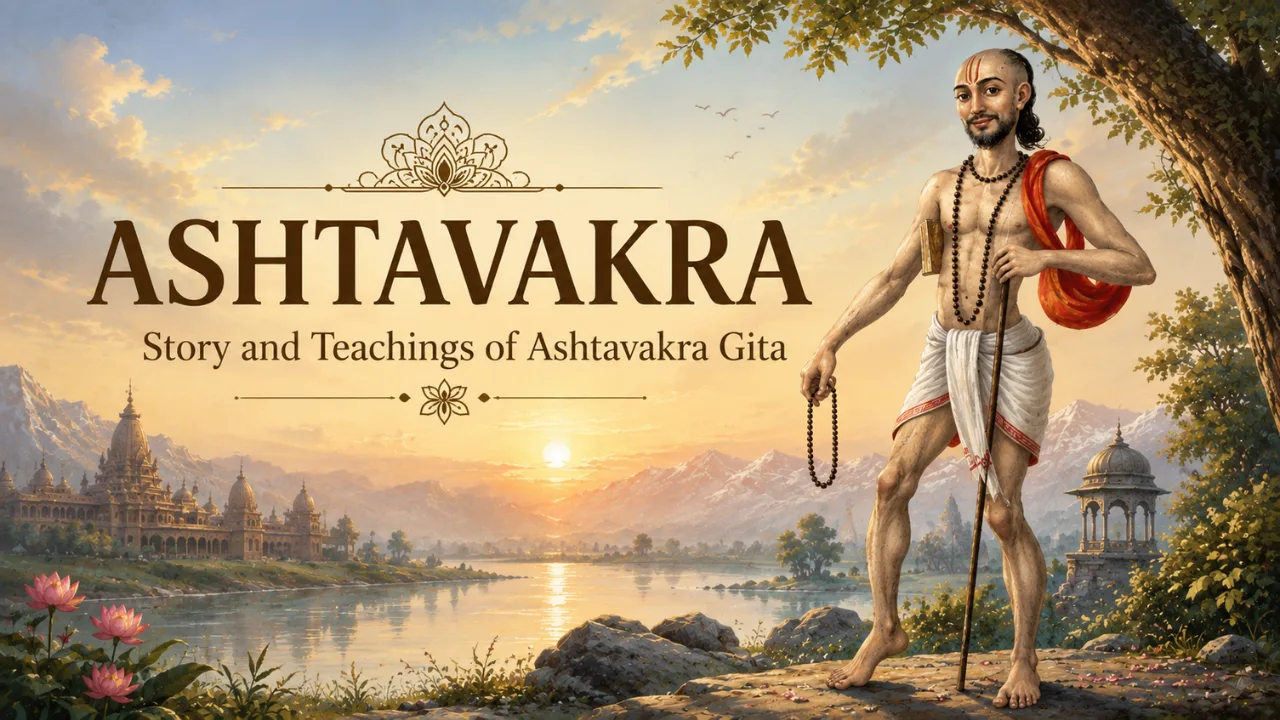
The world often judges people by what they can see—their face, their body, or the way they look. But sometimes, someone reminds us that true greatness never comes from appearance.
Ashtavakra, the sage who was born with eight deformities, teaches us the same lesson. His story is not just about an ancient sage; it’s a powerful lesson in believing in yourself, standing up for the truth, and finding the wisdom hidden within you.
Table of Contents
Who Was Ashtavakra?
Ashtavakra was an ancient Hindu sage, philosopher, and spiritual guru, best known for the Ashtavakra Gita, one of the most important texts of Advaita Vedanta (the philosophy of non-duality).
As per traditional stories, he was born into a family of great scholars. His father, Kahoda, was a learned sage and a disciple of the respected sage Uddalaka, and his mother, Sujata, was Uddalaka’s daughter. Right from the start, Ashtavakra was surrounded by wisdom and spiritual knowledge.
It is believed that he understood the Vedas even before he was born. As a child, he debated experienced scholars fearlessly and surprised everyone with his intelligence.
Why Was He Called Ashtavakra?
The name Ashtavakra has a simple meaning.
- Ashta means eight.
- Vakra means bent or crooked.
His body was bent in eight different places, which is why he came to be known as Ashtavakra.
While many focused on his appearance, Ashtavakra believed that judging someone by their body showed a lack of true understanding. According to him, the body changes over time, but the soul remains pure and unchanged.
Story Behind His Birth
According to Hindu mythology, Sujata was pregnant and Kahoda was reciting the Vedas aloud. The unborn child, Ashtavakra, heard the recitation and noticed a few mistakes.
The baby spoke from inside the womb and corrected his father’s pronunciation. Instead of being proud, Kahoda became angry and cursed the child to have eight bends in his body.
Soon after, Kahoda accepted an invitation to participate in a debate at the court of King Janaka. There he was defeated by a scholar named Bandi. Following the conditions of the debate, Kahoda was drowned underwater, leaving Sujata to raise Ashtavakra alone. (Kahoda didn’t die; the mystery was solved many years later).
Ashtavakra grew up without his father but inherited his family’s wisdom.
Story of Raja Janaka and Ashtavakra
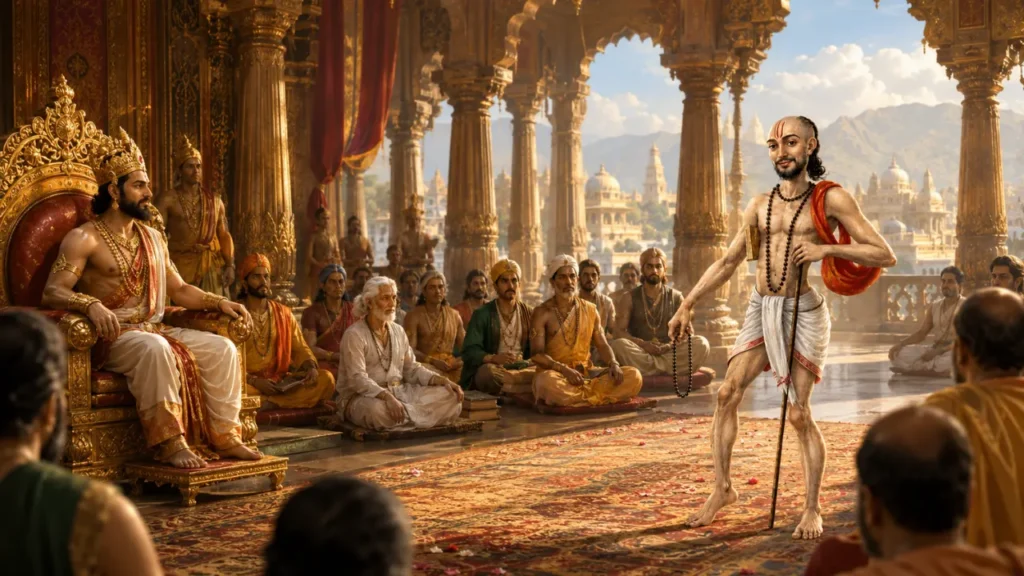
When Ashtavakra learned about what happened to his father, he decided to set out for the court of King Janaka, accompanied by his uncle, Shvetaketu.
The royal court was filled with scholars, ministers, and learned priests. But the moment Ashtavakra entered, many people laughed at his twisted body.
Instead of feeling embarrassed, Ashtavakra laughed too. On this, Raja Janaka asked, “Why are you laughing?”
Ashtavakra replied that he expected to find wise people in the king’s court, but instead he found people judging a person’s skin rather than their knowledge. According to him, anyone who judges only the body cannot truly be called wise.
Soon after, Ashtavakra challenged the scholar Bandi. The debate was intense and filled with deep discussions on the Vedas and philosophy. Ashtavakra answered every question with clarity and confidence.
In the end, Bandi accepted defeat and revealed the truth that he was the son of Varun Deva (god of waters). The 12 scholars he defeated (including Kahoda) did not die; they had been sent to perform a sacred ritual (yajna) for Varun Deva, and now they were free to return.
The entire court celebrated this reunion, and King Janaka became one of Ashtavakra’s greatest admirers. Their conversation later became the basis of the famous Ashtavakra Gita.
Return of His Father
After Bandi’s defeat, Kahoda returned safely and was overjoyed to see his son, who had rescued him.
According to traditional tales, Kahoda embraced Ashtavakra and asked him to bathe in the holy Samanga River (present-day Paryagraj).
The moment Ashtavakra stepped into the river, his body became straight, freed from its eight bends.
Some versions of the story describe this as the moment his father’s curse ended, while others show it as a symbolic event representing the victory of wisdom over suffering.
What Is the Ashtavakra Gita?
The Ashtavakra Gita is a beautiful conversation between Rishi Ashtavakra and Raja Janaka.
Unlike many other spiritual texts that focus on rituals, duties, or ceremonies, the Ashtavakra Gita goes directly to a powerful concept—real freedom comes from knowing your true self.
King Janaka asks about life, peace, and liberation, and Ashtavakra gives simple but deep answers. The book explains that we suffer because we attach ourselves to our bodies, thoughts, feelings, and material things.
However, Ashtavakra teaches that our true self is pure awareness—calm, limitless, and untouched by life’s highs and lows.
Even now, the Ashtavakra Gita is seen as one of the clearest and deepest books on self-realization.
Main Teachings of the Ashtavakra Gita
- You are not the body; your true nature is the eternal Self.
- Real happiness comes from within, not from worldly possessions.
- The mind creates most of our suffering.
- Attachment is the root of pain.
- Become a witness to your thoughts instead of getting trapped in them.
- Peace comes from understanding yourself.
- Freedom is not something to achieve; it is your natural state.
Related Read: While the Ashtavakra Gita emphasizes self-realization, the Bhagavad Gita offers practical wisdom for handling stress, relationships, success, and purpose. Explore our detailed guide on Bhagavad Gita Lessons for Gen Z to see how these timeless teachings remain relevant today.
Ashtavakra’s life remains an inspiration to many generations today. His journey teaches us that true strength comes not from a perfect body, but from a fearless mind and a clear understanding of our true selves.