
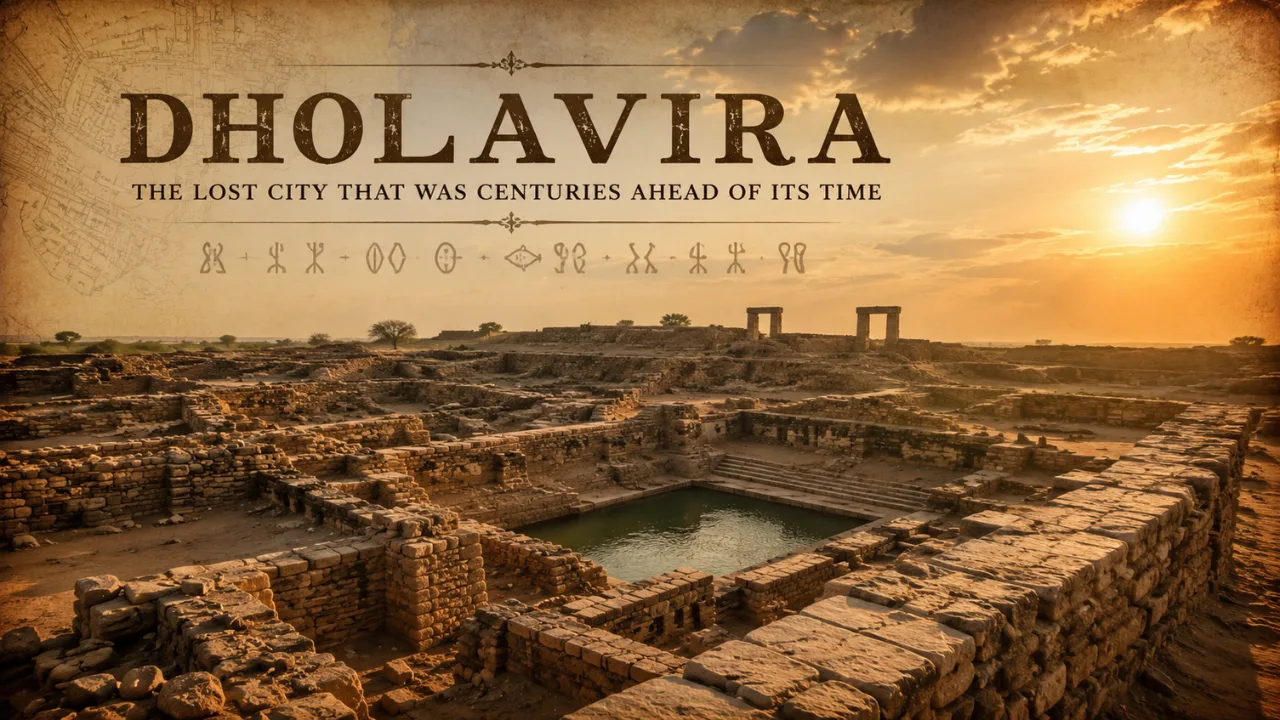
Have you ever imagined life in India over 4500 years ago?
Many of us imagined small villages with simple homes. But there existed a city with perfectly planned streets, water reservoirs, amazing stone buildings, and advanced engineering.
Dholavira is one of the greatest treasures of the Indus Valley Civilization. This ancient historical city remained hidden for thousands of years beneath the dry land of Gujarat.
Let’s have a journey into the past and uncover the mysteries of this incredible lost city.
Table of Contents
Where is Dholavira?
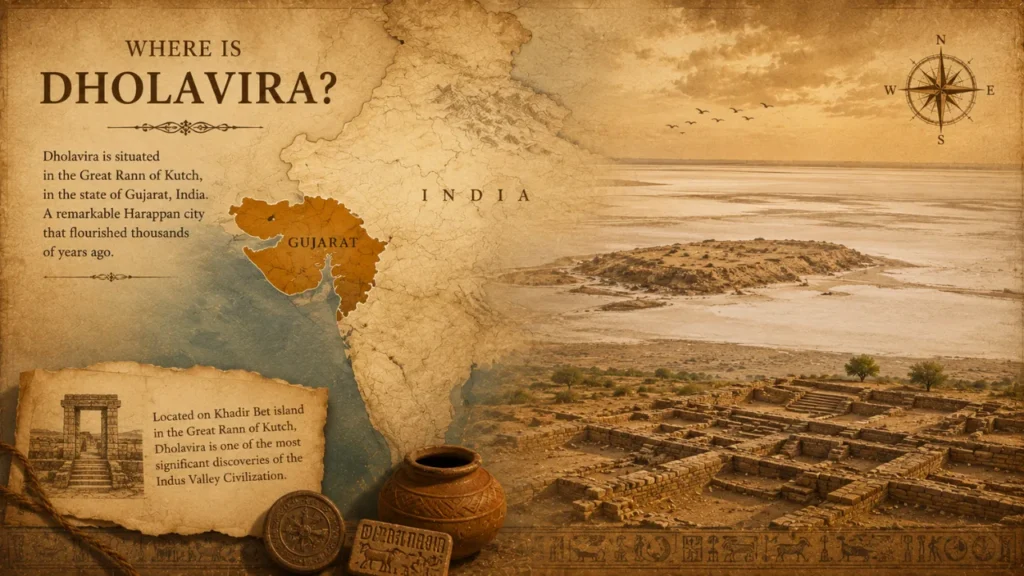
Dholavira, locally known as Kotada Timba, is located on the Khadir Bet island in the Great Rann of Kutch, Gujarat.
Today it may look like a dried area covered with salt, but thousands of years ago it was a part of a prosperous civilization.
The city was among the five largest settlements of the Indus Valley civilization.
It is one of the most important historical landmarks of India, and in 2021, Dholavira was recognized as a UNESCO World Heritage Site.
Discovery of Dholavira
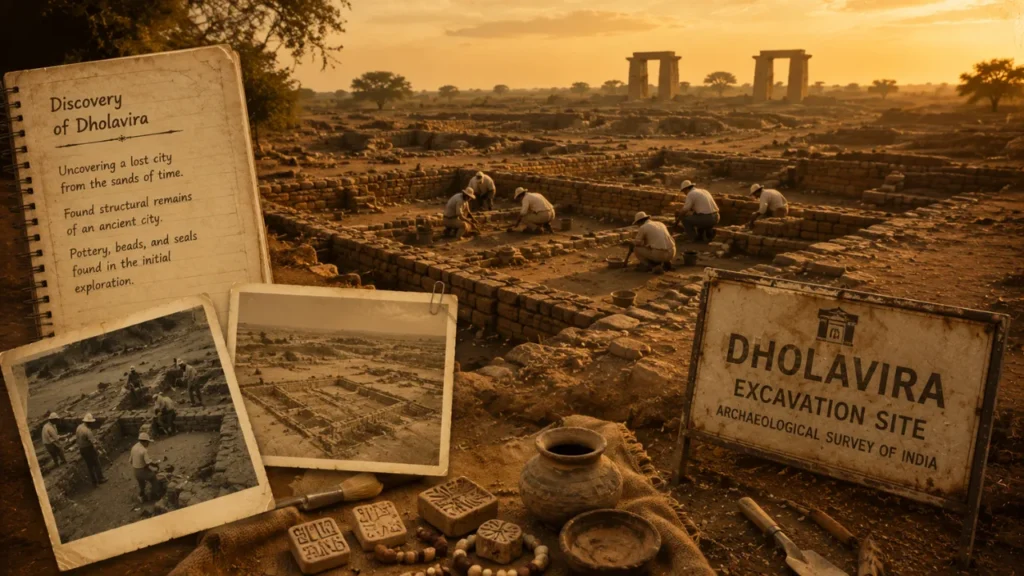
For centuries, Dholavira remained buried under layers of earth.
In 1967, archaeologist Jagat Pati Joshi first identified this site. Later, with detailed excavation, the Archaeological Survey of India revealed something extraordinary—a complete ancient city with roads, reservoirs, houses, and public spaces.
With the survey, it was clear that people who lived here were far more advanced than anyone had imagined.
Structure of Dholavira City
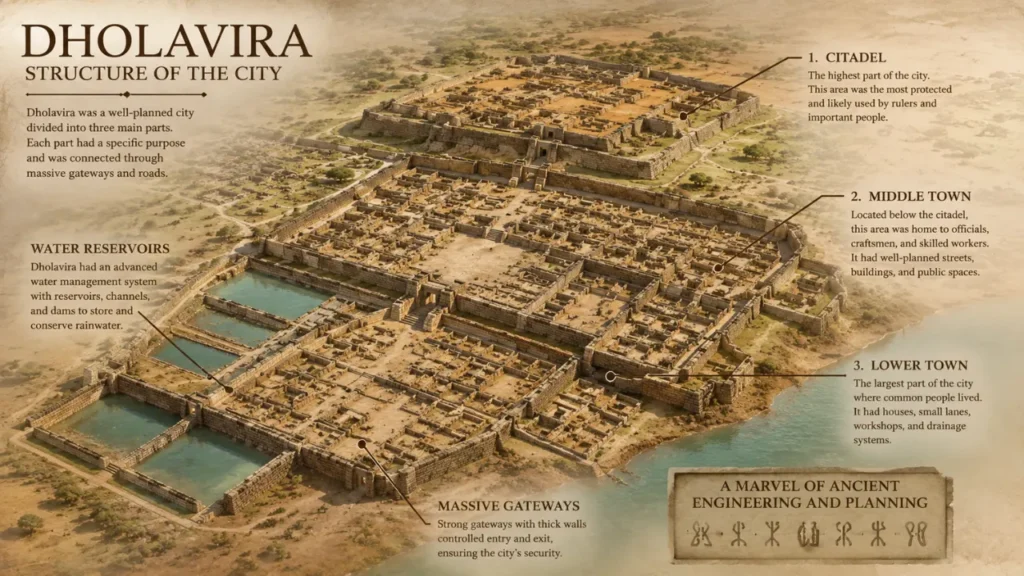
City planning of Dholavira is one of the most impressive things. The city was divided into three main sections:
- Citadel: The western elevated and fortified sector, which was divided into two subparts (the Castle and Bailey), served as the administrative hub and elite residential area.
- Middle Town: The center part of the city and the commercial zone, which housed official and skilled workers.
- Lower Town: The eastern residential sector, where most of the population lived.
The city was well-connected with wide roads, and the buildings were arranged in an organized way.
Amazing Water Management System
Water management was the greatest achievement of Dholavira.
Since the region received very little rainfall, people found smart ways to store water.
- 16 interconnected massive reservoirs carved directly out of stone, capable of holding over 100 million liters of water.
- Channels to collect rainwater
- Dams to control water flow
- Rock-cut wells to access groundwater.
These reservoirs are among the oldest and largest known water conservation systems in the ancient world.
Mystery of the Giant Signboard
Archaeologists found a large signboard with 10 huge symbols from the Indus script. It is considered to be one of the world’s earliest public signboards.
But no one knows what those symbols really mean. The Indus script has never been fully decoded. The message on that signboard will remain a great puzzle until someone unlocks its secret.
Discover another masterpiece of ancient India—the Konark Sun Temple.
Why Did Dholavira Disappear?
The biggest mystery is why the successful city of Dholavira disappeared.
There are several possible explanations. Some experts believe that climate change has caused rivers to dry up, making life difficult.
Earthquakes may also be a reason for the destruction of the place. Some also think that the trade routes changed, leading people to move to other regions.
The truth is, no one has a clear answer to this mystery.
Was Dholavira Connected to the Saraswati River?
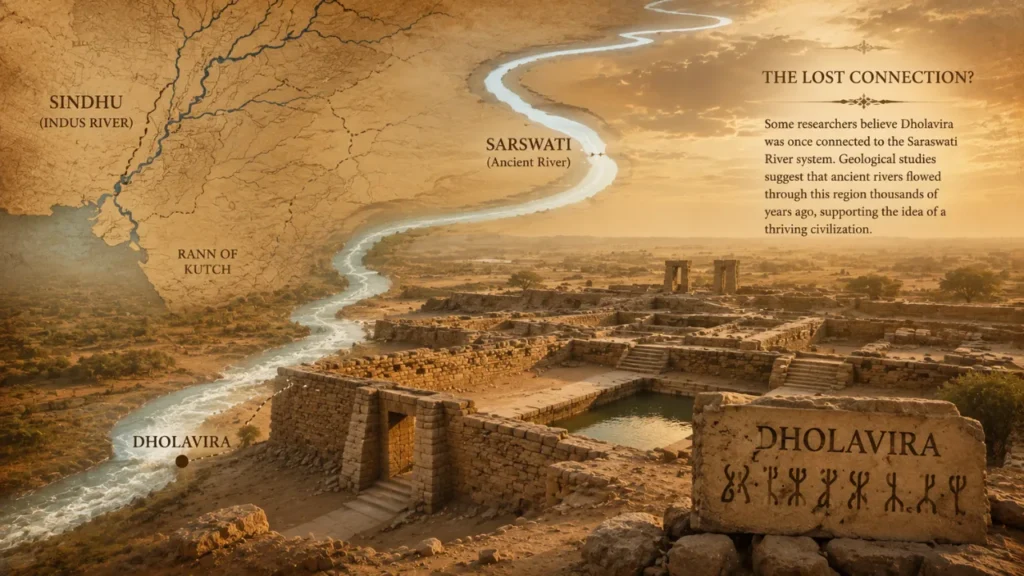
Some researchers believe that Dholavira may have once carried much more water than it does today.
The scientific studies indicate that Dholavira was historically connected with the now-extinct river system resembling the Vedic Saraswati River.
This adds an extra layer to the fantasy of Dholavira.
Fascinating Facts About Dholavira
Here are some quick facts:
- Dholavira is over 4,500 years old.
- It was one of the largest cities of the Indus Valley Civilization.
- The city was formed with giant stone structures.
- It had an advanced rainwater harvesting system.
- Discovery of one of the oldest public signboards.
- The city survived for more than a thousand years.
Final Thoughts
Dholavira is proof that ancient India was a home to brilliant engineers, skilled planners, and innovative thinkers who built such an advanced city thousands of years before the modern age.
The city reminds us that history still has many stories left to tell, and some of the greatest mysteries are still waiting to be solved.