
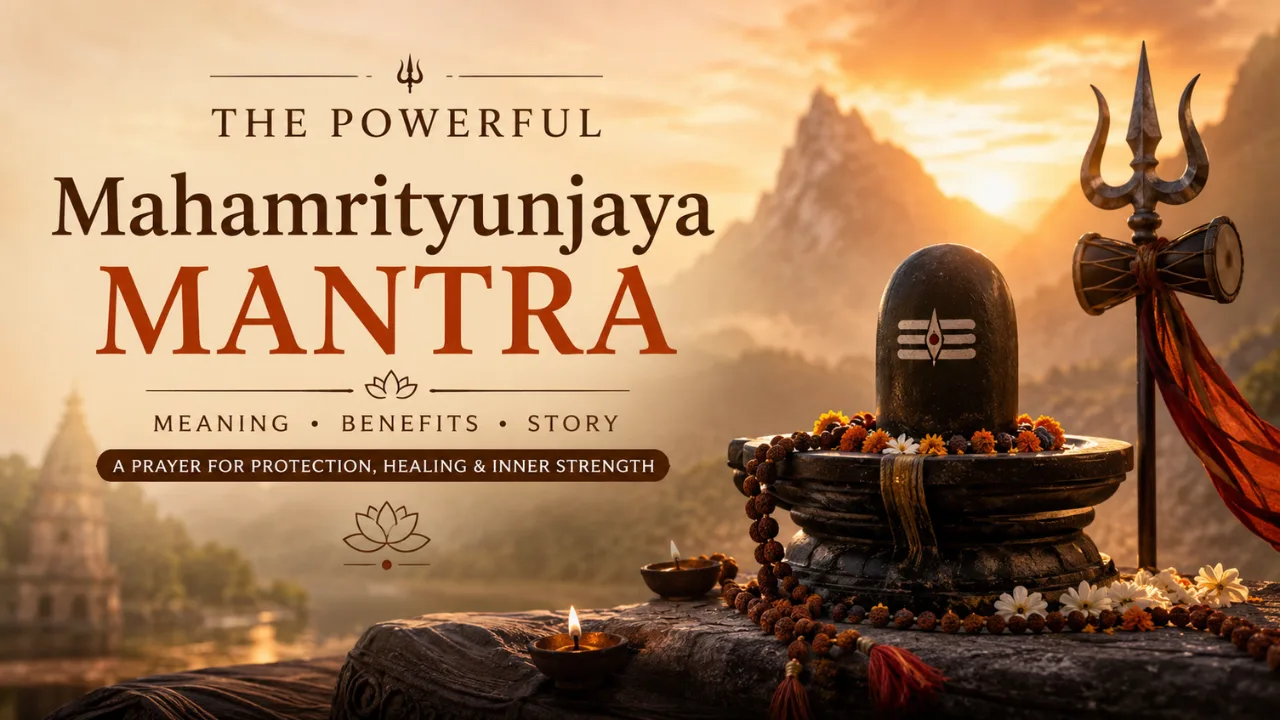
People have been chanting the Mahamrityunjaya mantra for centuries, especially in times of hardship, illness, prayer, and when seeking safety and strength. The name itself feels very powerful—Maha means great, Mrityu means death, and Jaya means victory.
Yet, a deep meaning lies within those ancient Sanskrit words. Let’s understand this ancient mantra in simple words.
Table of Contents
What Is the Mahamrityunjaya Mantra?
ॐ त्र्यम्बकं यजामहे सुगन्धिं पुष्टिवर्धनम्। उर्वारुकमिव बन्धनान्मृत्योर्मुक्षीय मामृतात्।।
oṃ tryàmbakaṃ yajāmahe sugándhiṃ puṣṭi-várdhanam । urvārukám iva bándhanān mṛtyór mukṣīya mā́ ‘mṛ́tāt
The Mahamrityunjaya mantra is one of the famous mantras dedicated to Lord Shiva. It is also known as the Tryambakam Mantra, because it refers to Shiva as Tryambaka, meaning the three-eyed one.
The mantra is essentially a prayer to Shiva asking for freedom from the fear and suffering associated with death and requesting a life full of strength, peace, and spiritual awakening.
Meaning of the Mahamrityunjaya Mantra
Word-by-Word Meaning
- Om—The universal sound, the cosmic vibration.
- Tryambakam—The three-eyed one (Shiva).
- Yajamahe – We worship or adore.
- Sugandhim—The one who spreads fragrance or goodness.
- Pushtivardhanam—The one who nourishes and strengthens all beings.
- Urvarukamiva—like a ripe fruit.
- Bandhanat—from bondage.
- Mrityor—from death.
- Mukshiya—Free us, liberate us.
- Ma Amritat—And grant us immortality.
This simply means that just as a ripe cucumber or fruit naturally detaches from the plant, we too can peacefully and effortlessly free ourselves from sorrow, fear, and worldly attachments.
Want to discover more ancient Hindu mantras? Check out 3 Powerful Mantras in Hinduism.
Why Is It Called the “Mahamrityunjaya” Mantra?
Mahamrityunjaya means “the great victory over death.”
But this doesn’t mean that chanting the mantra makes a person physically immortal.
Its deeper significance is about overcoming the fear of death, attachment, grief, and the limitations that keep us trapped in fear.
In Hindu philosophy, death is considered a natural part of life. The mantra reminds us to face that reality with courage rather than being constantly afraid.
Story of Rishi Markandeya
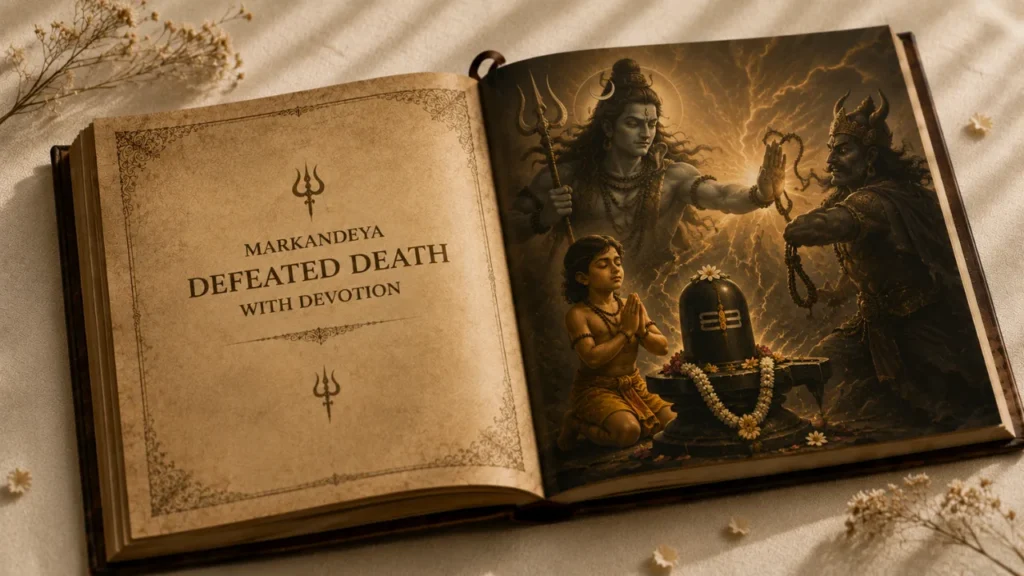
According to Hindu mythology, Sage Markandeya was born to Sage Marikandu and his wife, Marudmati.
His parents had a hard choice to make: either a highly intelligent son who lives a short life or an average son who lives a long life. They chose the intelligent one.
Markandeya grew up as a great devotee of Shiva. When he came to know the truth of his life, he performed great prayers to Shiva.
On the last day of his life, Yamaraja came and asked him to come with him. Markandeya refused and hugged the Shiva Lingam tightly.
His devotion became so powerful that Lord Shiva appeared and protected Markandeya, blessing him with a long life.
Importance of Mahamrityunjaya Mantra
The Mahamrityunjaya Mantra holds a special place in the Vedas and is considered one of the most powerful mantras for healing and protection. Its significance includes:
- Removes fear, anxiety, and negativity
- Protects against accidents and unexpected dangers
- Helps in times of illness or mental struggle
- Strengthens inner peace and emotional stability
- Deeply purifies the mind and soul
- Helps overcome challenges and obstacles
- Awakens spiritual energy and consciousness
How to Chant the Mahamrityunjaya Mantra
- Best Time to Chant
- Early morning (Brahma Muhurta)
- During meditation
- Before sleeping
- Steps
- Sit comfortably facing east or north.
- Keep your spine straight and breathe deeply.
- Light a lamp or incense if possible.
- Use a Rudraksha mala for counting (optional).
- Chant the mantra slowly and peacefully.
- Focus on Shiva or the Shiva Lingam while chanting.
- How Many Times to Chant
- 3 times (basic)
- 11 times (daily practice)
- 108 times (Why Is 108 Important in Hinduism?)
- Tips for Better Results
- Keep your mind calm
- Chant with devotion, not speed
- Avoid distractions
- Keep a peaceful intention
Uses of the Mahamrityunjaya Mantra
This sacred mantra is used in many spiritual and daily-life situations:
- During illness for healing
- In difficult times for protection
- Before traveling
- During meditation and yoga
- For cleansing the home
- In Mahamrityunjaya Havan
- For calming the mind and improving focus
Nothing in life is certain. We worry about our health, our loved ones, our future, and sometimes even things we can’t put into words.
The Mahamrityunjaya Mantra reminds us that we don’t always need all the answers. Sometimes, all we need is a little faith and the strength to keep moving forward.