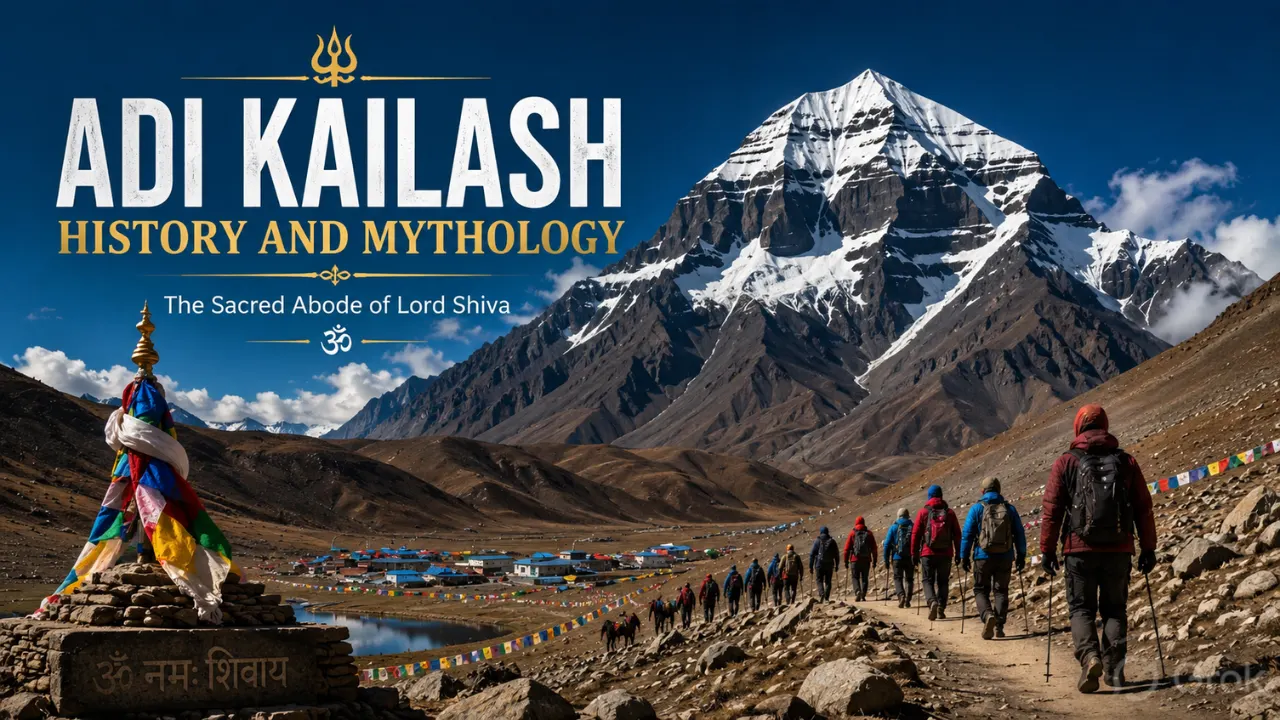
Adi Kailash is one of those sacred places of Lord Shiva where you can find yourself. It’s a place that has attracted saints, sages, pilgrims, and adventurers for centuries.
Also known as Chhota Kailash, it is believed to be one of the earthly abodes of Lord Shiva. While Mount Kailash in Tibet holds great significance in Hinduism, Adi Kailash offers pilgrims the opportunity to experience the same spiritual feeling without crossing the Indian border.
Table of Contents
What is Adi Kailash?
Adi Kailash is a sacred Himalayan peak in the Pithoragarh district of Uttarakhand, near the Indo-Tibetan border. Standing at around 5,945 meters (19,505 feet) above sea level, it is considered one of the most important pilgrimage sites dedicated to Lord Shiva.
The mountain is second among the famous Panch Kailash, the five abodes of Lord Shiva.
Why is it called Adi Kailash?
“Adi” is the Sanskrit word that means “first” or “original,” and “Kailash” refers to the home of Shiva. So Adi Kailash is the original Kailash where Shiva first resided with Devi Parvati.
According to local beliefs, Adi Kailash resembles Mount Kailash in both appearance and spiritual energy. Because of this resemblance, devotees started calling it Adi Kailash or Chhota Kailash.
Legends of Adi Kailash
Like many sacred places in the Himalayas, Adi Kailash is surrounded by stories that have been passed down from one generation to the next.
According to Hindu scriptures, Mahadev chose Adi Kailash to perform his eternal meditation. For thousands of years, he sat in deep meditation, filling the surroundings with divine spiritual energy that can still be felt today. This is the same place where Shiva tested the devotion of Devi Parvati, and impressed by her devotion, he agreed to marry her.
Adi Kailash is the place where Lord Shiva performed the Tandava (the cosmic dance) and revealed his complete form to Sage Ashtavakra.
It is believed that Shiva and Parvati wanted to stay close to their devotees, so they chose Adi Kailash as their second home, while the primary is Mount Kailash in Tibet.
Parvati Sarovar
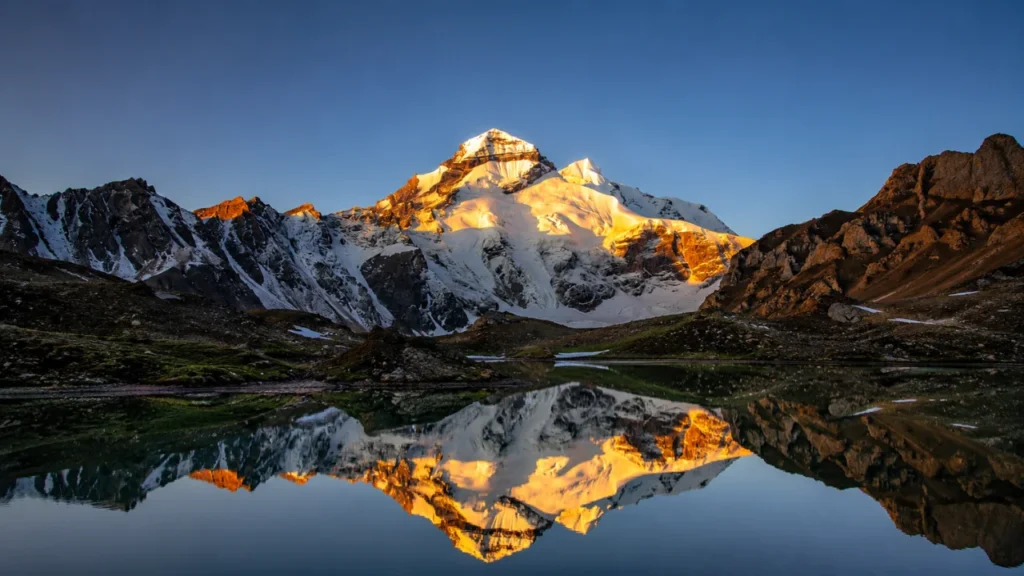
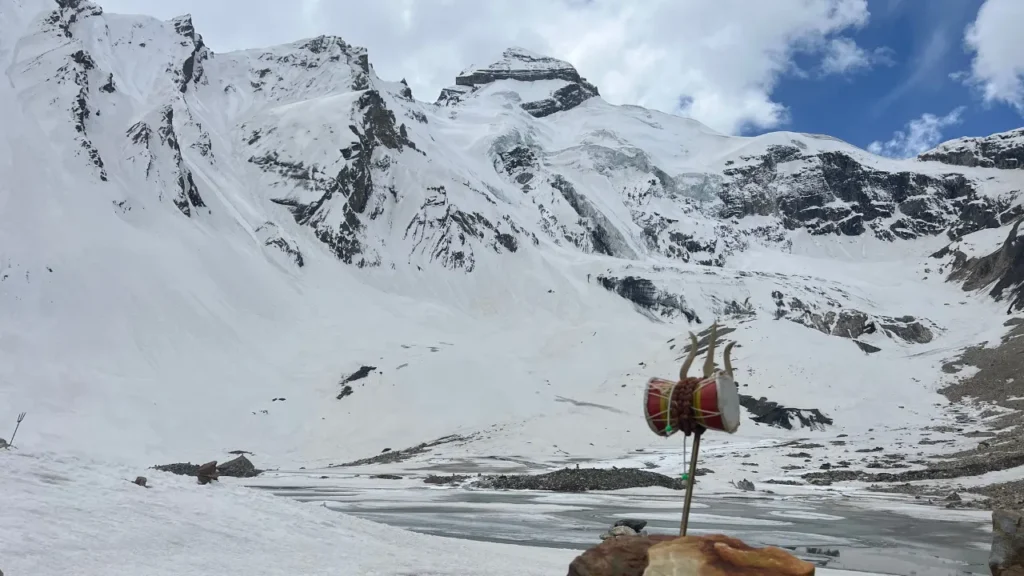
Parvati Sarovar, at an altitude of 4500 m, is the famous Shiva-Parvati Shrine.
It is believed that in this lake, Devi Parvati had performed her sacred bathing ritual. This sarovar has divine healing properties—not only for the body but also for the soul.
The still water beautifully reflects the peak of Adi Kailash, creating one of the most breathtaking views in the Himalayas.
Ancient texts also say that even divine beings from the higher realms (the devas and apsaras) descend to bathe in the sacred Parvati Sarovar. This suggests that the lake connects the earth to the higher dimensions.
Gauri Kund and the Ancient Shiva Temple
Gauri Kund, also known as Jolingkong Lake, is located at the foot of Adi Kailash at a height of 5608 meters.
Gauri is another name for Devi Parvati, and the lake Gauri Kund translates to Lake of Compassion. In Hinduism, the water of the lake is considered sacred, and people also offer prayers here.
There is a small old Shiva temple nearby, where pilgrims worship Lord Shiva and Goddess Parvati together.
Om Parvat
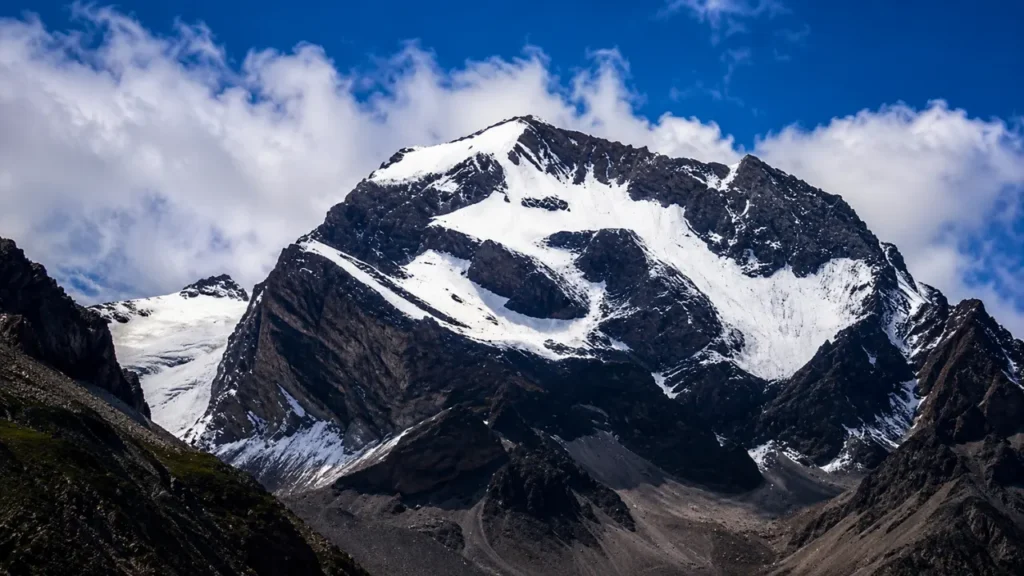
Among all the wonders of Adi Kailash, none is as famous as Om Parvat.
This snow-covered mountain naturally forms the sacred Hindu symbol “ॐ” (Om). Every year, the shape appears without any human involvement, representing that nature itself shows the presence of Shiva in the region.
In Hinduism, Om is regarded as the first cosmic sound from which the universe began. The symbol is clearly visible from a distance, and thousands of pilgrims stop here to offer prayers before continuing their journey.
Many locals also believe that there are eight mountains where nature forms the sacred symbol “ॐ.” As of today, Om Parvat in Uttarakhand is the only known mountain where this remarkable natural formation has been observed.
Vyas Valley and the Pandavas Connection
The Vyas Valley, which is the primary route to Adi Kailash, holds great significance in Hindu mythology. The valley is named after the great sage Ved Vayas, who is the narrator of the epic Mahabharata and the 18 Puranas.
It is believed that the sage meditated here, and in the same valley, Vyasa composed the scripture Mahabharata, specifically in the Vyas Gufa, or Vyas Cave.
The Vyas Valley is also associated with the Pandavas of the Mahabharata. It is believed that during their final journey to heaven, known as Mahaprasthan, the Pandavas passed through the same Himalayan region.
Buddhism’s Beliefs About Adi Kailash
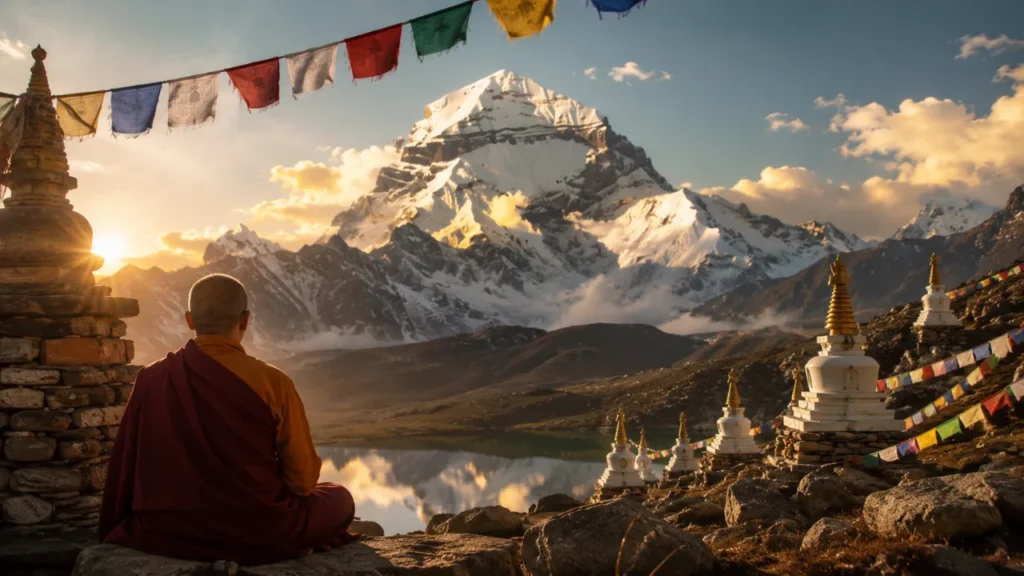
Although Adi Kailash is primarily known as a sacred place for Hindus, it is also spiritually significant in Buddhism.
Buddhists consider Adi Kailash (Chhota Kailash) a sacred part of the main Mount Kailash in Tibet. Both the mountains represent the Mandala—a spiritual space where heaven and earth meet.
They perform Kora (Parikrama) around the mountain, which is considered a way to wash away past sins.
Prayer flags can often be seen fluttering along parts of the Himalayan routes, representing hopes for peace, happiness, and well-being for all living beings.
Interesting Facts About Adi Kailash
- Adi Kailash closely resembles the sacred Mount Kailash in Tibet, which is why many devotees call it Chhota Kailash.
- The sacred symbol “ॐ” naturally appears on the snow-covered mountain every year, making it one of the greatest mysteries of the Himalayas.
- The creation of scripture, the departure of the Pandavas, and Adi Kailash all share the same Himalayan region of Vyas Valley.
- Before modern borders were established, the villages on the Adi Kailash route were part of an ancient Indo-Tibetan trade network.
- Some parts of the higher Himalayan region near Adi Kailash contain ancient marine fossils, which remind us that the mighty Himalayas were once beneath the ancient Tethys Sea