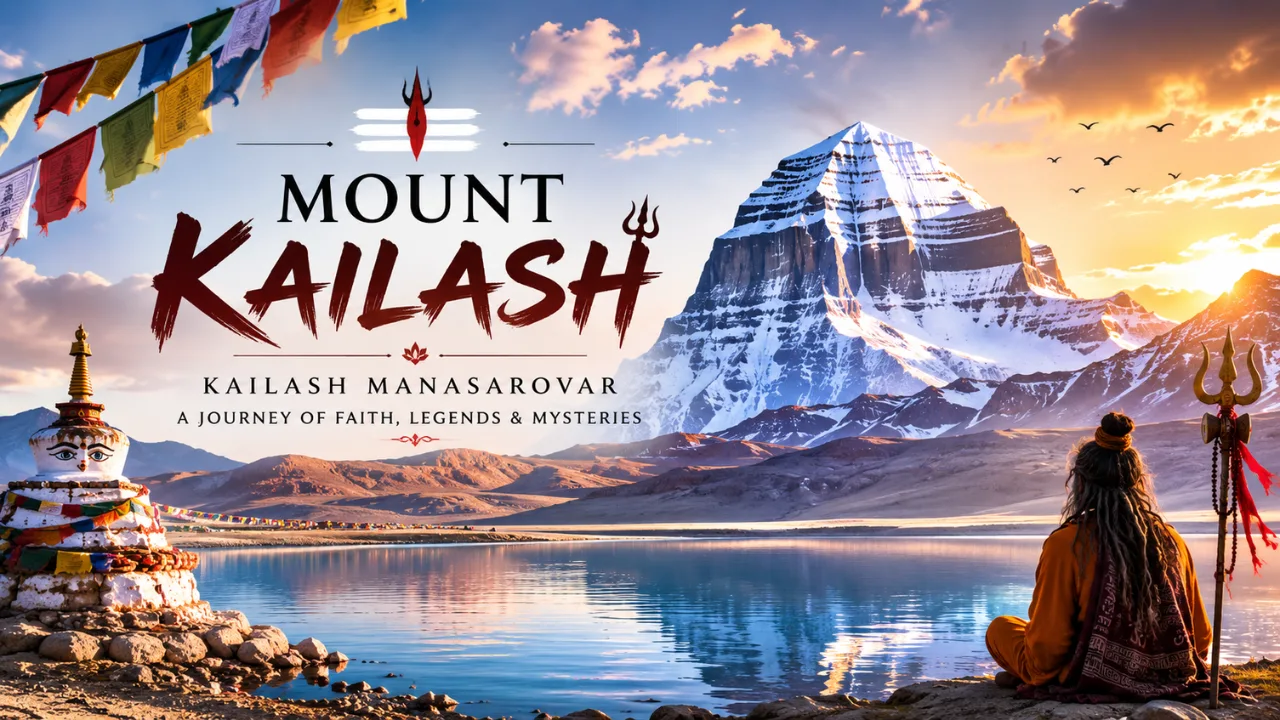
Since childhood, we’ve heard that Mount Kailash is the home of Shiva, where he sits in deep meditation with Devi Parvati.
But have you ever stopped for a moment and wondered why this particular mountain became so special? Why do millions of pilgrims dream of visiting Kailash at least once in their lives? And why, even in today’s world of advanced technology, has no one been able to climb it?
The more you read about Mount Kailash, the more questions begin to appear. So let’s discover why Mount Kailash continues to inspire faith, curiosity, and wonder even after thousands of years.
Table of Contents
What is Mount Kailash?
Before having a look into the legends and mysteries, let’s first understand what Mount Kailash actually is.
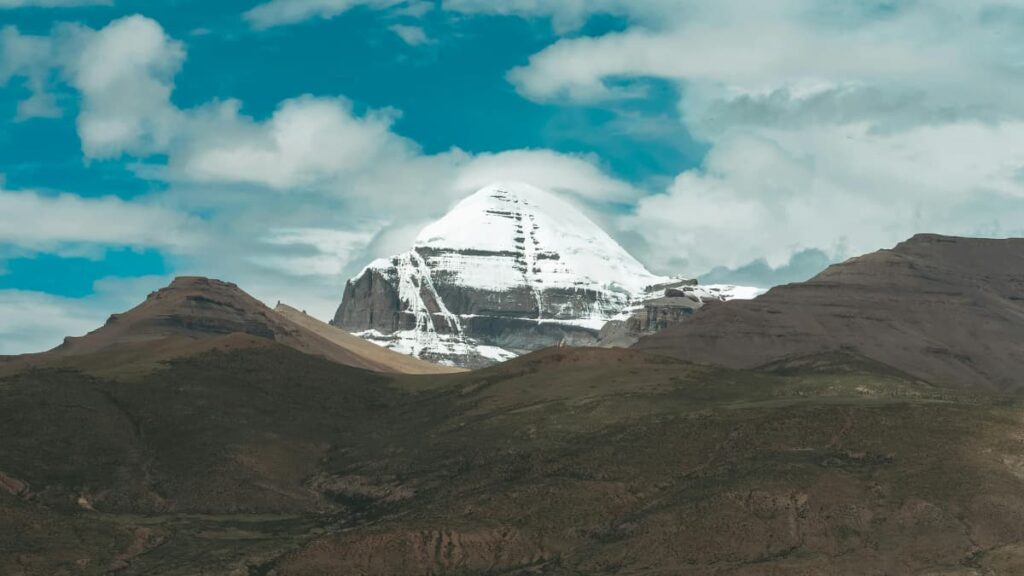
Mount Kailash is a sacred peak in the Nagri Region of Tibet, standing proudly at an altitude of 6638 meters (21778 ft). If seen from a distance, it reflects a unique appearance—the perfect pyramid shape with four steep faces pointing in different directions.
Unlike other mountains, where climbers celebrate reaching the summit, Mount Kailash is respected in a completely different way. People don’t visit it to conquer it—they visit it to bow before it.
Why is Mount Kailash so sacred?
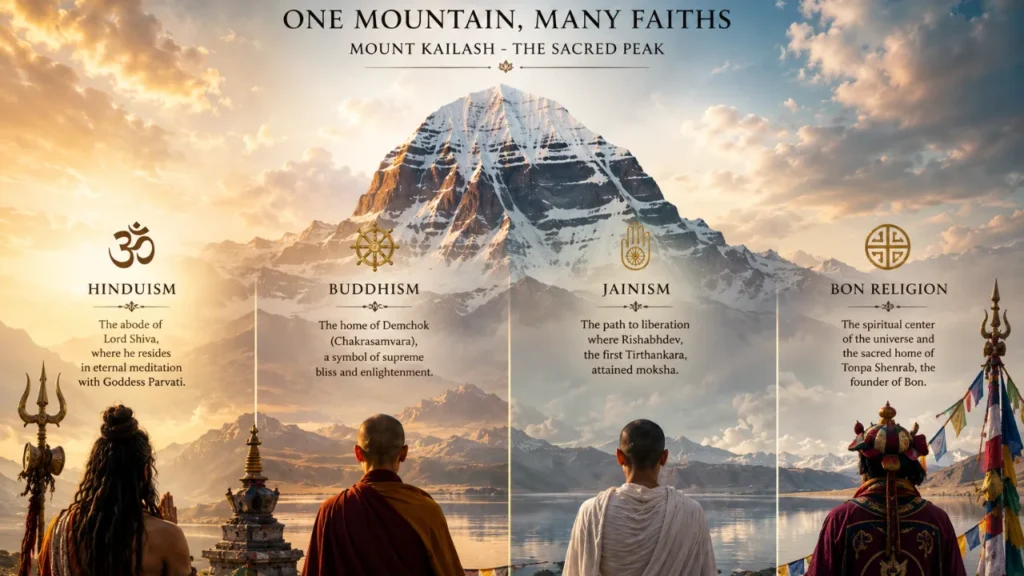
Usually, holy places belong to a single religion, but Kailash is different; it’s one of the few places in the world considered sacred by four religions.
Hinduism
According to Hindu beliefs, Kailash is the eternal abode of Lord Shiva and Devi Parvati. It is first among the Panch Kailash (the five sacred earthly abodes of Shiva). For devotees, visiting Kailash is not just a pilgrimage but a chance to feel close to Mahadev himself.
Buddhism
In Buddhism, Mount Kailash is considered the home of Demchok (Chakrasamvara), a deity who represents supreme wisdom and happiness. Many Buddhist monks dream of completing the sacred journey around the mountain.
Jainism
In Jain texts, Kailash is referred to as the Ashtapada Parvat. According to Jain belief, the first Tirthankara, Rishabhdev, attained moksha near Mount Kailash. Consequently, this mountain is highly revered in Jain traditions.
Followers of the Bon Religion
Long before Buddhism reached Tibet, the ancient Bon religion followers believed Mount Kailash was the centre of the spiritual world and the home of their founder, Tonpa Shenrab.
Legends of Mount Kailash
Mount Kailash is considered the center of the universe, where the earth and heaven meet. Various stories are associated with this holy place.
It is believed that Kailash is the home of Shiva, and he still meditates here, beyond the limits of time, while watching over the entire universe. That’s why people don’t see Kailash as a mountain—they see it as Mahadev himself.
Once, Ravana, the demon king and the great devotee of Shiva, tried to lift Kailash. He made the mountain tremble with all his strength. On this, Shiva simply pressed the mountain with his toe, trapping Ravana beneath it.
On realizing his mistake, he apologized and composed the famous Shiva Tandav Strotram. Pleased with his music and dedication, Shiva forgave him.
Mount Kailash and Lake Manasarovar
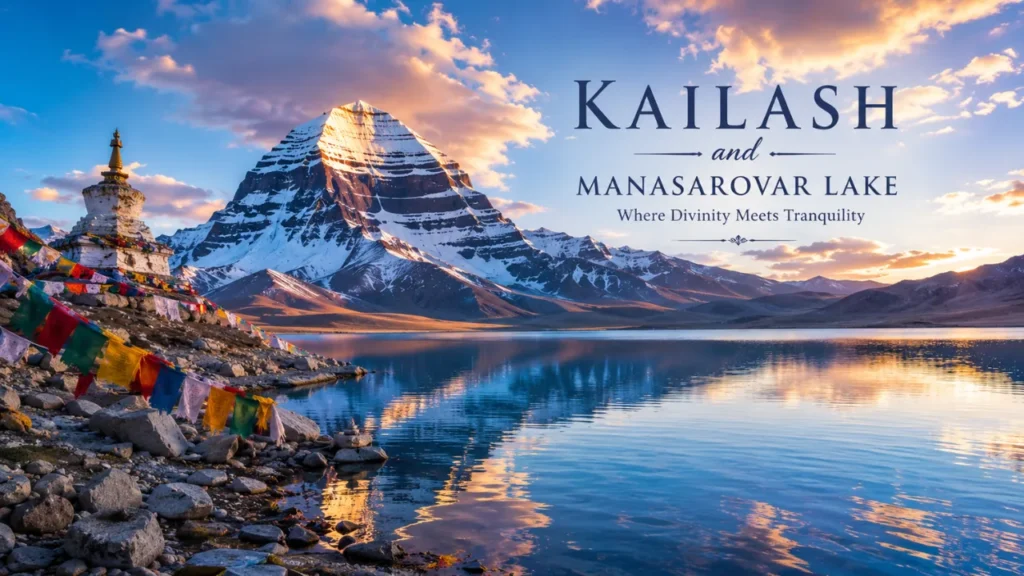
In the same region, there is another wonder—Lake Manasarovar—that lies just a few kilometres from Mount Kailash.
One of the highest freshwater lakes in the world, Manasarovar has deep roots in mythology also. Hindu beliefs hold that Lord Brahma created this lake in his mind before bringing it to Earth. This is why it is called Manasarovar—where Manas means mind and Sarovar means lake.
Many devotees take a holy dip in the lake, believing that its water cleanses not only the body but also the soul. Manasarovar Parikrama also has deep significance for pilgrims.
Right next to the peaceful Mansarovar is Rakshasa Tal, a lake associated with Ravana. While Mansarovar is considered sacred, Rakshasa Tal is often associated with fierce energy and dark myths.
Various mysteries and stories are associated with this lake; you can explore them also.
Kailash Parikrama (Kora)
Mount Kailash is so sacred that climbing it is not appreciated. Many attempts to climb it have failed.
Devotees believe climbing it insults the divine power present here, so they walk around the mountain, which is called Kailash Parikrama or Kora. It is about 52 kilometers long and usually takes three days to finish.
The toughest part of the journey is crossing Dolma La Pass, which stands at around 5,630 meters. The climb is steep, the oxygen is low, and the cold winds make it even more challenging.
Some Tibetan devotees take this devotion to another level. Instead of simply walking, they perform full-body prostrations throughout the entire Parikrama.
According to Hindu beliefs, completing one Parikrama washes away the sins of a lifetime. Completing 108 Parikramas is believed to lead a soul toward liberation.
Learn why 108 is so special in Hinduism.
How to Reach Mount Kailash
Because Mount Kailash is located in Tibet, travellers require several permits, and trips are usually organized through authorized tour operators.
For Indian pilgrims, one of the most popular routes is through the Lipulekh Pass in Uttarakhand, which is part of the official Kailash Mansarovar Yatra.
Another common route begins in Kathmandu, Nepal, where pilgrims continue their journey by road and, in some cases, by helicopter and then enter Tibet.
The journey is just as memorable as the destination.
Mysteries of Mount Kailash
Over so many years, it has become one of the most mysterious places in the world. Even though some stories are based on faith, and some are still unproven, they still keep sparking curiosity.
- No one has ever officially climbed Mount Kailash.
- The mountain has an almost perfectly symmetrical pyramid-like shape.
- Many ancient traditions describe it as the center of the world or the Axis Mundi.
- Four major rivers of Asia—the Indus, Sutlej, Brahmaputra, and Karnali (a tributary of the Ganga)—originate close to the Kailash region.
- Birds avoid flying directly over the mountain.
- Some people hear the Om sound in the region.
For devotees, these mysteries are signs that there is some divine energy present in this area, which is beyond human limitations.
Conclusion
Mount Kailash is a mountain that touches your heart.
No matter what brings you here—faith, curiosity, adventure, or simply a love for old stories—it is almost impossible to leave without connecting to this sacred mountain in some way
Maybe not every mystery surrounding Mount Kailash will ever be solved.
Because sometimes, the beauty of a place lies not in finding all the answers, but in keeping the wonder alive.