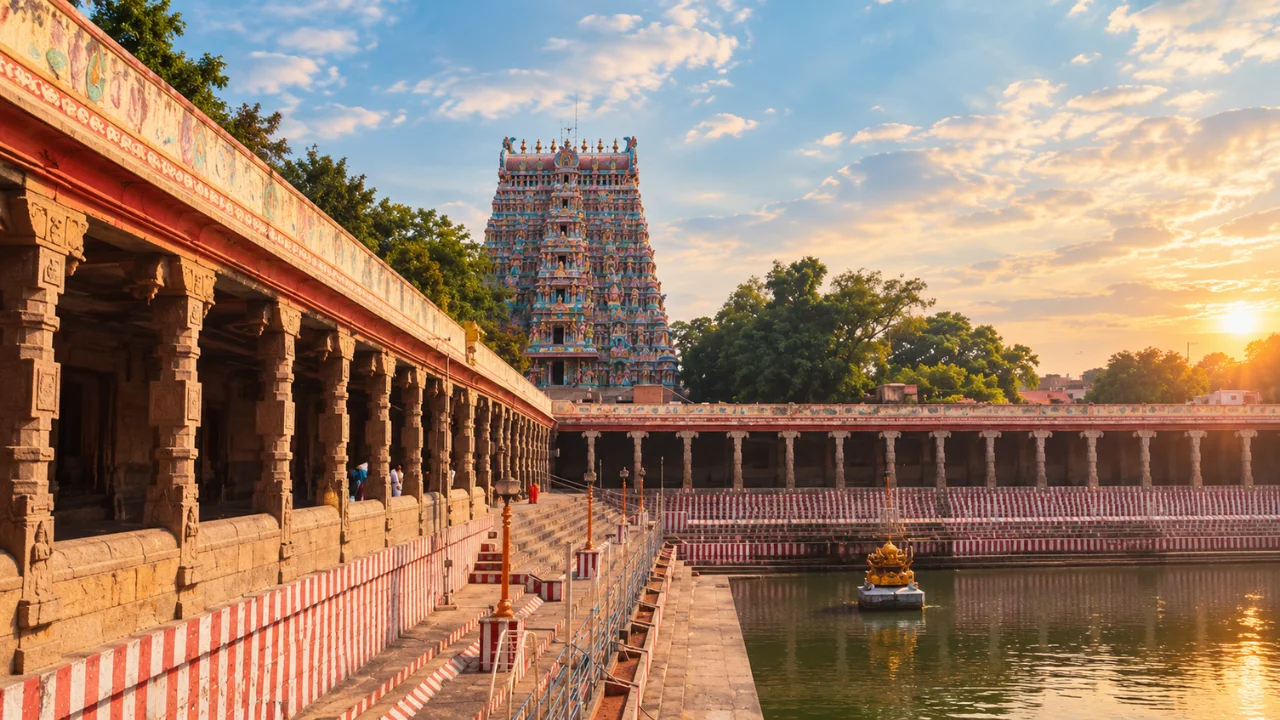
One of South India’s most famous historical landmarks is the Meenakshi Amman Temple in Madurai, Tamil Nadu. The temple, dedicated to Goddess Meenakshi and Lord Sundareswarar, is famous for its magnificent gopurams, intricate sculptures, grand halls, and centuries-old traditions.
But behind its colorful architecture lies something even more fascinating—stories of a powerful goddess, the divine marriage of Meenakshi and Sundareswarar, and a temple that has shaped the identity of Madurai for centuries.
Table of Contents
Where Is Meenakshi Amman Temple?
Meenakshi Amman Temple, officially known as Sri Meenakshi Sundareswarar Temple, is located in Madurai, Tamil Nadu. It sits on the southern banks of the Vaigai River.
The temple is dedicated to two main deities: Goddess Meenakshi, a form of Goddess Parvati and Lord Sundareswarar, a form of Lord Shiva. The beautiful story of both the deities has lived in the heart of Madurai for centuries.
Story of Goddess Meenakshi
According to the temple’s traditional story, the Pandya king Malayadhwaja Pandya and his wife Kanchanamala prayed for a child. During a special ritual, a girl with three breasts appeared from the sacred fire. She was the goddess Parvati herself, born as Meenakshi (one with fish-shaped eyes).
A divine voice said that her third breast would disappear when she met her destined partner. The girl was born to become a great ruler. She grew up to be a brave warrior and eventually set out on a journey to conquer different lands.
When she met Shiva, she recognized him as her partner. Shiva came to Madurai as Sundareswarar, and their divine wedding became one of the main stories associated with the temple.
Even today, the marriage of Meenakshi and Sundareswarar is celebrated with great enthusiasm during the famous Meenakshi Tirukalyanam festival.
History of Meenakshi Amman Temple
The Madurai District Administration says the temple dates back about 2,000 years, growing over time under different rulers and dynasties. Still, the structure you see today is the result of centuries of rebuilding, remodeling, and expansion.
The most difficult period in its history came in the 14th century, when the temple was attacked by Malik Kafur. The temple suffered extensive damage, and many sculptures and paintings were destroyed.
The temple was later rebuilt and expanded under the Vijayanagara rulers, especially the Madurai Nayaks. Under Viswanatha Nayaka, the temple complex was expanded and strengthened. Later, Thirumalai Nayaka played a key role in adding and developing several structures around the temple.
Famous Gopurams of Meenakshi Temple
Gopurams are among the beautiful features of this temple, which are the entrance towers decorated with thousands of mythological sculptors. It appears that deities, mythical beings, and figures from Hindu legends are found in nearly every section of the towers.
The temple complex has 14 major gopurams, including four main outer gateways aligned with the cardinal directions and ten smaller ones distributed throughout the inner courtyards.
The Southern Gopuram is the tallest among all, standing at approximately 52 meters.
Thousand Pillar Hall
One of the most famous parts of the temple is the Aayiram Kaal Mandapam, commonly known as the Thousand Pillar Hall. It was built in 1569 by Ariyanatha Mudaliar during the Nayak dynasty.
The hall is carved from a single massive rock, with its pillar depicting the carvings of gods and goddesses from Hindu mythology. Each of these pillars tells a unique story, offering a glimpse into Madurai’s rich cultural heritage.
Musical Pillars
Another interesting feature of the temple is its musical pillars. These unique granite structures are known to produce different musical notes when gently tapped. Located on the western side of the Thousand Pillar Hall, it offers an experience unlike any other.
For a temple that is already visually stunning, these pillars create a fascinating link between architecture and sound. It is a minor detail, but it shows the immense thought and craftsmanship invested in the temple’s design.
Golden Lotus Pond
Inside the temple complex is the Pottramarai Kulam, also known as the Golden Lotus Pond. This sacred water tank is also known by the names Adhi Theertham, Sivaganga and Uthama Theertham.
According to the legends, Lord Shiva created this pond by striking the ground with his trident (soolam), and no aquatic life is found in the sacred water. In the center of the pond sits a prominent golden lotus structure, which gives the tank its name.
In ancient times, this pond served as a judgment ground for ancient Tamil literature. Scholars from the famous Sangam assembly would place their new manuscripts on the water. If the poem was high-quality literature, the manuscript would float; if it was poorly written, it would sink.
Nataraja Idol
There’s another interesting feature inside the temple that many visitors find fascinating.
Velli Ambalam (the Silver Hall) houses a Nataraja idol of Lord Shiva, dancing with his right leg raised. This is unusual because Nataraja is usually depicted with his left leg raised.
According to the traditional story of the temple, a Pandya king, a devotee of Shiva, asked him to change his dancing posture because he felt that holding a single leg for so long would cause pain. It is said that Shiva changed his posture for his devotee.
Festivals at Meenakshi Amman
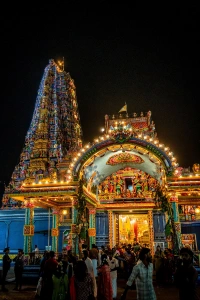
The temple becomes especially lively during its major festivals. The most famous is Meenakshi Tirukalyanam, also known as the Chithirai Festival, which celebrates the divine wedding of Meenakshi and Sundareswarar.
Another important celebration is the Theppotsav, or float festival, traditionally held at the temple’s associated sacred tank, which is celebrated on the full moon night of the Tamil month of Thai.
In the month of August, the temple celebrates the Aavani Festival, which is an 18-day-long festival to commemorate the coronation of Lord Sundareswarar and the 64 sacred miracles (leelas) of Lord Shiva.
Navratri is also an important festival. During this nine-day period, Goddess Meenakshi is dressed in different attire each day in the Kolu Mandalam.
Best Time to Visit Meenakshi Temple
During warmer months, Madurai can be quite hot. For a more comfortable temple visit, morning or evening time can be a good option.
Winters are usually considered the idle months for the visit. If you want to see the temple at its best, you can plan your visit around one of its major festivals. Just keep in mind that crowds can be more frequent during festivals.
How to Reach Meenakshi Temple
Meenakshi Amman Temple is located in the centre of Madurai, so reaching it is relatively convenient.
By Air: Madurai Airport is the nearest airport. Find affordable flight deals for your trip.
By Train: Madurai Junction is well connected with several major cities in India.
By Road: Madurai has good road connections with other cities in Tamil Nadu and neighbouring states.
Meenakshi Amman Temple is one of those places that is difficult to understand through photographs alone. Colorful gopurams, big halls, fine sculptures, and old stories are great, but the real experience is standing inside the temple and watching it all come together.
For anyone interested in Indian temples, Hindu mythology, history or South Indian architecture, Meenakshi Amman Temple is a place worth experiencing at least once.