

To most of us, applying a tilak is just something we have seen all our lives. We just put a little red kumkum, sandalwood paste, or yellow turmeric between the eyebrows, and that’s it.
But why exactly the forehead? Is there actually any science behind this old Indian tradition, or is it simply a religious practice?
The answer is a little more interesting, so let’s understand it in simple words.
Table of Contents
What Exactly Is a Tilak?
A tilak is a mark applied on the forehead. Depending on the region, family, or festival, it can look very different.
- Kumkum
- Sandalwood or Chandan
- Vibhuti or sacred ash
- Tumeric
- Gopi Chandan
Some people wear a small round dot, while others have vertical or horizontal lines.
Why Is Tilak Applied Between the Eyebrows?
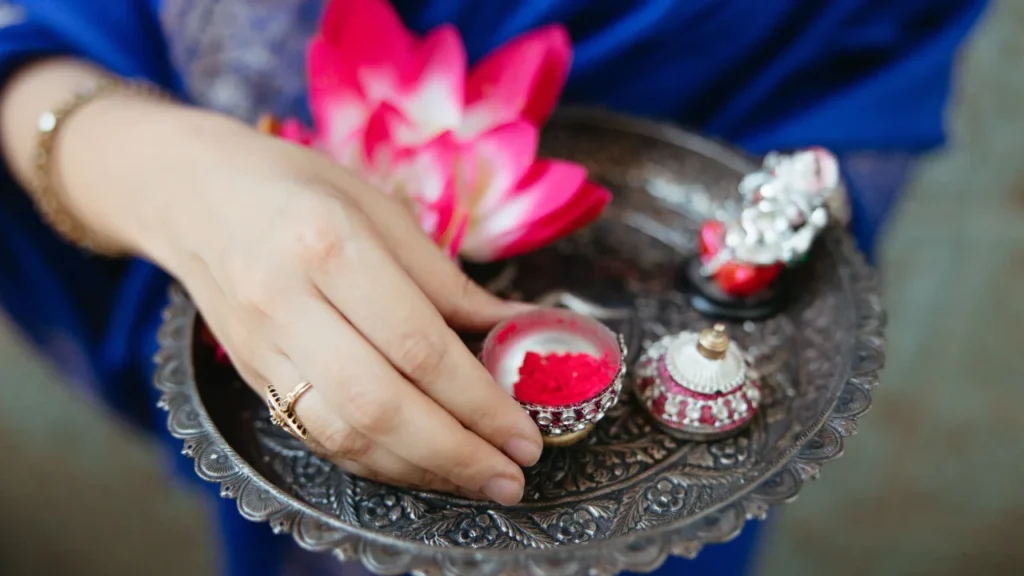
Traditionally, the area between the eyebrows in yoga is called the Ajna Chakra, which is frequently known as the “third eye.”
In Hinduism this point is connected with awareness, concentration, intuition, and inner understanding.
Scientifically also, this point is considered very important, as this area contains many nerves and sensory structures. Touching or applying something here makes us more aware of the sensation and helps us to bring our attention to the present moment.
Can Tilak Help With Concentration?
When someone applies tilak on your forehead, you immediately notice it.
That subtle feeling can increase your awareness of that area and act as a simple reminder to keep your concentration during prayer or meditation. This is why the forehead holds such significance in Indian spiritual traditions.
Curious about the science behind another Indian ritual? Read why Hindus break coconuts before auspicious occasions.
Benefits of Different Types of Tilak
People in India have been using sandalwood for centuries. This is partly because it is cooling and soothing. Putting sandalwood paste on the skin gives a cooling sensation, which is especially pleasant in India’s hot climate.
Traditionally, kumkum has been associated with auspiciousness, devotion, and prosperity. The red colour also makes the mark visually noticeable. Practically speaking, a small mark on the forehead can remind us of the tradition or purpose behind it.
Turmeric has been a part of Indian households for thousands of years. It contains a compound called curcumin, which has been widely studied for its antioxidant and anti-inflammatory properties. Traditionally, turmeric was valued for its cleansing and medicinal properties, which is why it became a part of many Indian rituals.
Gopi Chandan is a sacred yellow-white clay from Dwarka and Gopi Talav. It marks the surrender and devotion to Lord Krishna. According to traditions, it is believed that it purifies the body when applied to 12 sacred spots. It keeps the thoughts calm and focused during meditation.
Applying sacred ash (vibhuti or bhasma) on the forehead provides spiritual focus, reminds one that life is just for a while, and helps cool the mind.
Why Do Different People Wear Different Tilaks?

There has never been just one way of doing things in India. Different communities have different traditions, and the tilak is a great example of this diversity.
Some Vaishnava traditions use vertical marks, while Shaiva traditions commonly use horizontal lines of vibhuti.
Depending on the occasion and tradition, sandalwood, kumkum, turmeric, and sacred ash can be used. So, the tilak is not just about science. It also tells a story about a person’s culture, spiritual tradition, and beliefs.
Want to understand the logic behind more Indian customs? Read our guide to the science behind Indian traditions.
Final Thoughts
The science behind applying the tilak isn’t about proving that every ancient belief was secretly a scientific discovery. Instead, it reveals how a simple custom can hold multiple meanings.
Some of the explanations are supported by science, while others belong to the world of faith and tradition. But behind that little mark lie centuries of Indian culture, belief, and wisdom.